Types of Belt Type AI NIR Sorter
What Is a Belt-Type AI NIR Sorter?
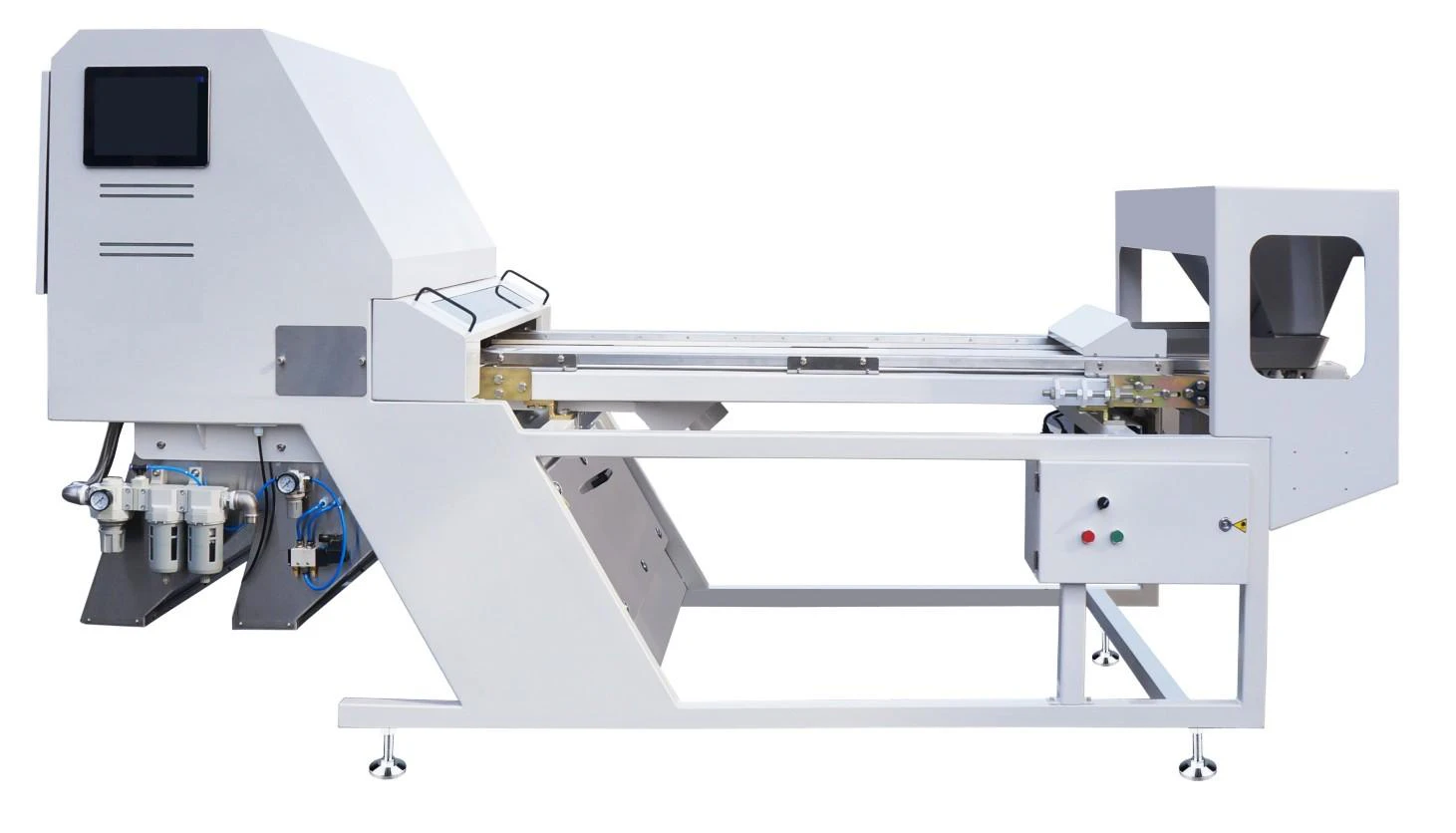
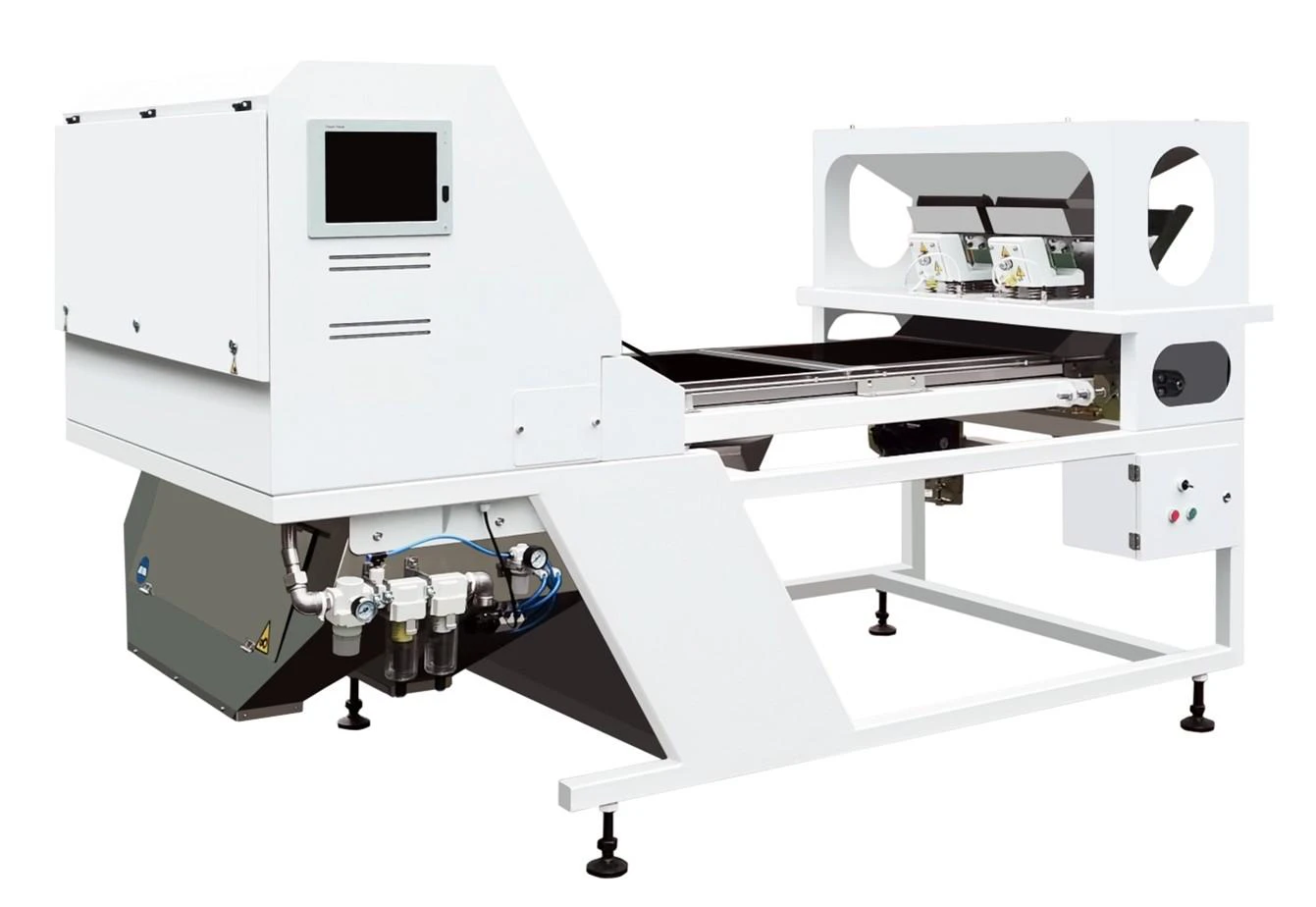
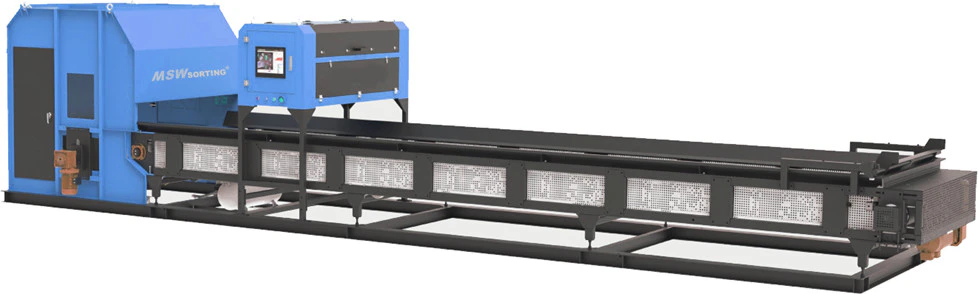
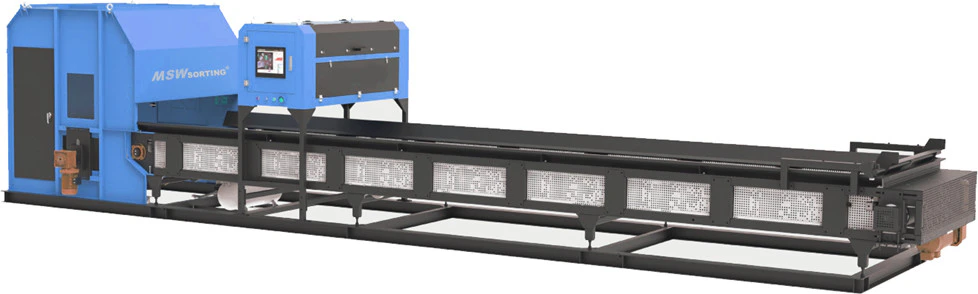
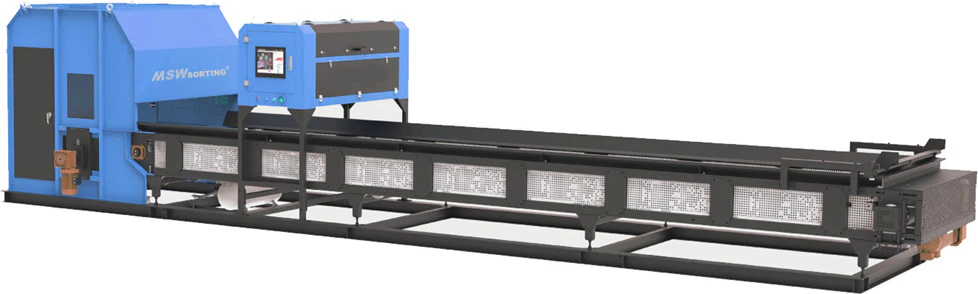
A belt-type AI NIR sorter is an automated separation machine that spreads mixed plastic material across a moving conveyor belt, scans each fragment with near-infrared light, and uses artificial intelligence to decide where every piece belongs. Also known as a belt sorting machine or a near-infrared belt sorter, this equipment sits at the heart of modern plastic recycling lines, where speed and purity determine whether recovered material can be sold as high-grade feedstock. The device combines three tightly integrated systems: a stable conveyor that carries and presents the material, an optical sensing head that reads the chemical signature of each object, and a computer that interprets that signal and triggers a precise ejection response. Because these subsystems work as one continuous chain, the machine can process several tons of plastic per hour without an operator manually touching the stream.
The word "belt" in the name is not a minor detail. It describes the physical transport principle that shapes everything else about the machine. Instead of letting material free-fall past a sensor, the belt-type near-infrared sorter holds each object in a fixed, predictable position while it moves under the scanning window. This stability matters because near-infrared spectroscopy needs a clear, steady view of the surface it is reading. When material tumbles or bounces unpredictably, the optical reading becomes noisy and classification accuracy drops. By carrying the plastic on a flat, controlled surface, the belt design gives both the sensor and the AI model the consistent conditions they need to make reliable decisions, which is why this configuration has become a standard choice for demanding recovery applications.
How Near-Infrared Spectroscopy Identifies Polymers
Near-infrared spectroscopy works by shining light in the roughly 900 to 1700 nanometer range onto the surface of a plastic fragment and measuring how that light is absorbed and reflected. Every polymer contains chemical bonds, mostly involving hydrogen, carbon, and oxygen, and each type of bond vibrates in a characteristic way when it interacts with infrared energy. Those vibrations absorb specific wavelengths, leaving a distinctive pattern in the reflected light that acts like a molecular fingerprint. When the sensor captures this spectral pattern, it can distinguish PET from PE, PE from PP, and so on, because each of these materials leaves a subtly different signature. This is fundamentally different from a color camera, which only sees appearance; the near-infrared sensor sees composition.
The strength of this approach is that it identifies material by what it is chemically made of rather than by how it looks. Two bottles that appear identical to the human eye can be made from completely different resins, and near-infrared scanning separates them instantly. The spectral data captured at each point on the belt is compared against reference libraries and, in advanced systems, against learned models that recognize thousands of subtle variations. Because the reading happens at the speed of the moving belt, the sorter builds a detailed compositional map of the entire material stream in real time. That map is what allows the downstream mechanism to target only the fragments that match the desired output, whether the goal is to recover pure PET flakes or to remove a specific contaminant from an otherwise clean stream of polyolefins.
The Role of AI and Deep Learning in Material Recognition
Traditional near-infrared sorters relied on fixed spectral thresholds: if a reading fell within a defined band, the material was labeled a certain way. This works well for clean, single-layer plastics, but real recycling streams are messy. Fragments are dirty, wet, printed, laminated, or partially overlapping, and these conditions distort the raw spectral signal. Artificial intelligence, and specifically deep learning, addresses this problem by training on enormous datasets of real spectra collected under imperfect conditions. Instead of following rigid rules, the model learns the underlying patterns that survive noise, so it can still recognize PET even when the surface is soiled or the label obscures part of the object. This adaptability is the core reason AI-driven recognition outperforms rule-based systems on difficult material.
Deep learning also excels at handling mixed and ambiguous flows where several polymers appear together in rapid succession. The model does not evaluate one wavelength at a time; it interprets the full spectral shape as a whole and weighs many features simultaneously, much as an experienced technician would draw on years of pattern recognition. As new material types enter a facility, the AI can be retrained or fine-tuned, meaning the machine improves over time rather than becoming obsolete. In practice this translates to higher purity in the recovered product and fewer good pieces mistakenly rejected. For a plant that is judged on the cleanliness of its output, that combination of higher accuracy and lower loss directly affects how much saleable material comes off the line each shift.
Belt Conveyor vs. Free-Fall Feeding
Sorting machines generally present material to the sensor in one of two ways: on a belt conveyor or through a free-fall chute. In a free-fall design, material slides down an inclined chute and is scanned as it drops through the air past the sensor and ejection nozzles. In a belt design, material rides on a fast-moving conveyor and is scanned at the moment it leaves the end of the belt. The choice between these two arrangements is not about which is universally better; it is about which matches the material being processed. The belt conveyor approach exists because many materials simply do not behave well in free fall.
The belt provides a stable platform that keeps each object flat, spread out, and moving at a known, uniform velocity. This is critical for accurate ejection, because the computer must predict exactly where a target fragment will be when the air nozzles fire a fraction of a second after scanning. When velocity and position are predictable, that prediction is precise. Flat items, films, and large or irregular pieces tend to flutter, tumble, or slide unpredictably in a chute, which scatters both the optical reading and the ejection accuracy. By pinning these materials to a moving surface, the belt-type near-infrared sorter keeps them under control from the scanning point through to separation, delivering consistent results on exactly the material types that chute feeding struggles with.
How Does a Belt-Type AI NIR Sorter Sort Plastics?
The sorting process is a continuous, high-speed sequence that turns a chaotic mix of plastic into cleanly separated output streams. Although it happens in a fraction of a second per fragment, the operation can be understood as four connected stages: feeding and spreading the material on the conveyor, scanning it with the near-infrared sensor, classifying each piece with the AI system, and finally ejecting the targeted fragments with precisely timed bursts of air. Each stage depends on the one before it, so the overall accuracy of the machine reflects how well these steps are tuned to work together. Understanding this flow makes it easier to see why belt stability, sensor quality, and computing speed all matter to the final result.
Step 1 — Material Feeding and Spreading on the Conveyor Belt
Sorting begins long before the sensor sees anything, at the point where material is fed onto the conveyor. A feeding system, often a vibrating tray or metering hopper, releases material at a controlled rate so that fragments arrive in an even, single layer rather than in clumps or piles. This spreading step is one of the most underrated parts of the entire process. If pieces overlap or stack on top of one another, the sensor can only read the surface it can see, and the ejection system cannot cleanly separate two objects that occupy the same spot. A well-spread stream, by contrast, gives every fragment its own clear space for scanning and removal.
The conveyor belt then accelerates the material to a constant, high speed. This acceleration serves two purposes: it thins out the layer of material further, and it establishes the stable, known velocity that the ejection calculation later depends on. Because the belt surface is flat and continuous, flat films, curved fragments, and large irregular pieces are all carried in a fixed orientation rather than tumbling. By the time the material reaches the far end of the belt, it is presented to the sensor as an orderly, predictable stream. The quality of this presentation sets an upper limit on how well the rest of the machine can perform, which is why feed rate and belt speed are among the first parameters tuned during commissioning.
Step 2 — NIR Scanning and Spectral Data Capture
As material travels beneath the scanning window, a near-infrared sensor illuminates the belt across its full width and reads the reflected light many thousands of times per second. The sensor does not take a single snapshot; it builds a continuous line-by-line spectral image, so that every position across the belt and along its length is associated with a measured spectrum. This produces an extremely detailed compositional picture of the moving stream, capturing not just what materials are present but exactly where each fragment sits at each instant. That spatial precision is essential, because knowing the position of a target is just as important as knowing its identity.
The raw spectral data captured here is the foundation on which every later decision rests, so the design of the sensing head has a direct effect on accuracy. Higher spectral and spatial resolution allows the system to distinguish similar polymers and to detect smaller fragments. Stable, uniform illumination ensures that a piece near the edge of the belt is read as reliably as one in the center. Because the belt holds material flat and moving at a known speed, the sensor receives clean, well-registered readings rather than the smeared or partial signals that unstable feeding would produce. All of this captured data is streamed immediately to the processing system, where the identity of each fragment is determined without any perceptible delay in the flow of material.
Step 3 — AI Classification and Decision Making
Once the spectral data arrives, the AI system takes over the job of interpretation. For every point in the compositional image, the model determines which polymer or material category the reading corresponds to, and then groups neighboring points into distinct objects. This is where the machine decides not only "what is this" but also "does this piece belong in the accept stream or the reject stream," based on the sorting task the operator has configured. The decision must be made in real time, because the material is already racing toward the end of the belt where ejection will happen. Modern processing hardware handles this workload for the entire belt width simultaneously, keeping pace with the continuous flow.
The intelligence of this stage is what separates a good sorter from an ordinary one. The AI model must handle borderline cases, such as a fragment whose spectrum is partly obscured by a printed label or a film of dirt, and still reach a confident, correct conclusion. It weighs the full spectral pattern rather than a single feature, which lets it reject contaminants that a simpler system would miss while avoiding the mistake of ejecting valuable material. The system also calculates precisely where each targeted fragment will be located a moment later, translating each classification decision into a specific instruction for a specific set of air nozzles. In effect, the AI produces a firing map that tells the ejection hardware exactly which nozzles to activate and when.
Step 4 — Air Nozzle Ejection and Product Separation
The final stage physically separates the material based on the decisions the AI has made. A dense array of high-speed air nozzles is positioned at the end of the belt, where fragments leave the conveyor and briefly travel through the air along a natural trajectory. When a targeted piece reaches the ejection zone, the specific nozzles aligned with its position fire a short, sharp burst of compressed air. That burst pushes the fragment off its normal path and into a separate collection channel, while pieces that are not targeted continue along their original trajectory into a different channel. The result is two cleanly divided streams from what began as a single mixed flow.
The precision of this step depends entirely on timing and position, which is exactly why the stable belt feeding described earlier matters so much. Because the belt delivers every fragment at a known speed and location, the system can predict the trajectory and fire the correct nozzles within milliseconds, hitting a small moving target without disturbing its neighbors. Fine nozzle spacing allows the machine to remove even small fragments individually, and short air pulses conserve compressed air, which is one of the larger operating costs of this equipment. When ejection is well tuned, the machine achieves both high purity, meaning few unwanted pieces slip into the product, and high yield, meaning few good pieces are wasted. Balancing these two goals is the essence of a well-configured separation stage.
What Plastics Can a Belt-Type AI NIR Sorter Detect?
A belt-type AI near-infrared sorter can reliably identify and separate the great majority of common thermoplastics found in packaging, industrial, and consumer waste streams. Because it reads chemical composition rather than appearance, it can distinguish between resins that look identical and can pull a single unwanted polymer out of an otherwise clean stream. That said, the technology has clear boundaries defined by the physics of near-infrared light, and it is important for a buyer to understand both what the machine detects well and where it needs support from complementary technologies. Alongside material chemistry, the shape and size of the material also decide whether a belt-fed or chute-fed configuration is the better fit.
Detectable Polymers — PET, HDPE, PVC, LDPE, PP, PS
The core strength of near-infrared sorting lies in identifying the standard family of packaging polymers. PET, the resin used in beverage bottles and food trays, has a strong and distinctive spectral signature that the sensor recognizes with high confidence. HDPE and LDPE, the polyethylenes used in bottles, containers, and films, are equally readable, and the system can even help separate rigid from flexible forms when combined with shape analysis. Polypropylene, or PP, common in caps, tubs, and automotive components, is another material the sensor handles routinely. PVC and PS round out the group of everyday plastics that the machine can detect and sort into their own clean fractions.
What makes this capability commercially valuable is not just detection but discrimination. A recycling plant rarely needs to know that plastic is present; it needs to separate PET from PVC because even a small amount of PVC contamination can ruin a batch of recycled PET. The near-infrared sorter excels at exactly this kind of fine separation, targeting one polymer for removal while leaving the rest untouched. It can also sort by grade within a single polymer family when the spectral differences are sufficient. Because the AI model can be trained on the specific material mix a facility handles, the same machine can be configured to chase different targets on different days, making it a flexible tool rather than a single-purpose one.
Limitations — Black Plastics and Carbon-Loaded Materials
The most significant limitation of near-infrared sorting involves black and dark-colored plastics, and the reason is rooted in how the technology works. Many black plastics are colored using carbon black pigment, and carbon black absorbs infrared light almost completely across the wavelengths the sensor uses. When light does not reflect back, there is no spectrum to read, and without a spectrum the material cannot be identified. As a result, a fragment of black plastic often appears simply as an absence of signal, and the sorter cannot tell whether it is PET, PP, or something else entirely. This affects a meaningful share of automotive, electronic, and consumer goods waste, where dark colors are common.
This boundary does not make the machine less useful; it defines where additional technology is needed. Some facilities pair near-infrared sorting with other sensing methods, such as specialized detectors or alternative spectroscopy that can characterize carbon-loaded material, to close this gap. Others simply accept that black plastics will report as unidentified and route them to a dedicated stream for separate handling. Buyers evaluating this equipment should quantify how much of their feed is dark or carbon-filled, because that figure determines whether near-infrared sorting alone will meet their recovery targets or whether a hybrid approach is warranted. Being clear-eyed about this limitation up front prevents disappointment and leads to a system design that actually matches the material coming through the door.
Why Belt Feeding Suits Flat, Film, and Irregular Materials
Beyond chemistry, the physical form of the material strongly influences whether a belt-fed sorter is the right tool. Belt feeding is particularly well suited to flat items, thin films, and large or irregular fragments, because the conveyor holds these shapes flat and carries them in a stable orientation. A sheet of film, for example, would flutter unpredictably in free fall, scattering both the sensor reading and the air ejection. On a belt, that same film lies flat and moves at a constant, known speed, giving the sensor a clean view and the nozzles a predictable target. The same logic applies to bulky, oddly shaped pieces that would tumble erratically in a chute.
A helpful way to picture the distinction is to think about sorting different kinds of produce. A large, light, irregular item like a lemon behaves much better when carried on a belt, where it can be presented steadily to the sensor, whereas a stream of small, uniform grains like rice flows smoothly and predictably down a chute. The plastics equivalent holds true: small, regular pellets and granules tend to suit chute feeding, while sheets, films, and large or misshapen fragments call for the control that a belt provides. Choosing feeding based on material form, not just material chemistry, is one of the most important decisions in specifying a sorter, and it is precisely why both belt and chute configurations continue to exist side by side.
Belt-Type NIR Sorting vs. Chute-Type NIR Sorting
Belt-type and chute-type near-infrared sorters share the same sensing and AI technology but differ fundamentally in how they present material to the sensor, and that single difference cascades into distinct performance profiles. In a chute sorter, material slides down an inclined surface and is scanned in free fall, which works beautifully for small, dense, free-flowing particles that behave consistently in the air. In a belt sorter, material rides on a conveyor and is scanned as it leaves the belt, providing the stability that larger, flatter, and more irregular material requires. Neither is inherently superior; the correct choice follows directly from the size, shape, and flow behavior of the feed material a facility processes.
Throughput, Stability, and Material Size Considerations
When comparing the two configurations, the decisive factors are material size, positional stability, and the resulting throughput for a given material type. Chute-type sorters typically shine with fine fractions and granular material, often in the range of small particle sizes, where free fall keeps particles moving quickly and evenly. For such material, a chute can deliver very high throughput per unit of belt width because the particles are small and densely presented. However, as material becomes larger, flatter, or more irregular, free-fall behavior grows unpredictable, and the chute's accuracy suffers because pieces tumble and separate erratically during the drop.
Belt-type sorters take the opposite position on this spectrum. By holding material flat and moving it at a controlled speed, they maintain stability across a much wider range of shapes and sizes, particularly for films, sheets, and coarse or bulky fragments. This stability translates into consistent ejection accuracy and reliable purity even when the feed is heterogeneous. The practical rule that emerges is straightforward: choose a chute sorter when the material is small, uniform, and free-flowing, and choose a belt sorter when the material is flat, filmy, oversized, or otherwise difficult to keep stable in free fall. Many large facilities operate both types in sequence, using each where it performs best, and a well-designed line matches every stream to the feeding method that gives it the cleanest, most predictable presentation to the sensor.
What Industries Use Belt-Type AI NIR Sorters?
Belt-type AI near-infrared sorters have become essential wherever mixed plastic material must be turned into clean, marketable fractions at industrial scale. Their combination of high throughput, chemical-level identification, and tolerance for large or irregular material makes them a natural fit for operations that handle diverse and challenging waste streams. Across recycling, waste management, and specialized material recovery, the same underlying capability delivers value: automatically producing purer output than manual sorting could achieve, at speeds that manual labor cannot match. The following sectors represent the most established and demanding applications for this equipment.
Plastic Recycling and Regranulation Plants
Plastic recycling and regranulation plants are the heartland of near-infrared belt sorting, because the entire economics of their business depends on output purity. A regranulator melts recovered plastic and reforms it into pellets that will be sold as raw material for new products, and the value of those pellets rises sharply with their cleanliness. Even minor cross-contamination, such as PVC mixed into a PET stream, can degrade an entire batch or make it unsuitable for its intended use. The belt-type sorter allows these plants to hit tight purity specifications by removing off-spec polymers and contaminants before the material ever reaches the extruder.
These facilities also benefit from the belt configuration's ability to handle the flakes, fragments, and washed material that dominate a recycling line. After bottles and containers are shredded and washed, the resulting flakes are often flat and varied in shape, exactly the kind of material that belt feeding stabilizes well. By placing near-infrared sorting at strategic points in the process, a regranulation plant can perform both a coarse separation of major polymer types and a fine polishing step that removes the last stubborn contaminants. The AI's ability to be retrained on the plant's specific material mix means the same machine keeps performing as input streams shift over time, protecting the plant's ability to meet buyer specifications consistently.
Waste Management and Material Recovery Facilities (MRF)
Material recovery facilities, commonly abbreviated MRF, receive the commingled recyclables collected from households and businesses and must separate this jumbled stream into distinct commodities. This incoming material is highly variable, containing mixed plastics alongside paper, metal, and glass, and it arrives at very high volumes. Belt-type near-infrared sorters are deployed at the plastic separation stage to identify and divide the polymer fractions, turning a chaotic mixed bale into defined streams of PET, HDPE, and other recoverable resins. The high throughput of belt systems is essential here, because an MRF must keep pace with the continuous arrival of collected material.
What makes near-infrared sorting so valuable in this setting is its ability to replace or dramatically reduce error-prone manual picking. Human sorters cannot reliably distinguish polymer types by sight, especially at high line speeds, and cannot sustain the pace that modern facilities demand. An automated sorter reads chemistry directly and never tires, producing consistent purity across an entire shift. Because the material at an MRF is so heterogeneous, including large films and irregular items, the belt configuration's stability is a genuine advantage over free-fall feeding. Integrated into a broader sorting line, these machines let a facility recover more saleable commodity from each ton of incoming waste while reducing the labor and safety burdens of manual handling.
Electronics and Automotive Shredder Residue Recovery
The recovery of plastics from electronic waste and end-of-life vehicles presents some of the most difficult sorting challenges in the industry, and belt-type systems are well suited to the coarse, mixed material these streams produce. When electronics and automobiles are shredded, they yield a complex mixture of engineering plastics, metals, and composite fragments, often in large and irregular shapes. This shredder residue contains valuable technical polymers such as ABS and PC that can command strong prices when recovered cleanly, giving processors a real incentive to invest in precise separation.
Belt feeding handles the bulky, irregular fragments typical of this material far better than free fall could, keeping pieces stable enough for accurate reading and ejection. At the same time, these streams highlight the technology's limitations, because electronic and automotive plastics are frequently colored with carbon black, which near-infrared light cannot penetrate. Processors in this sector therefore often combine near-infrared belt sorting with complementary detection methods to address the dark-plastic gap, using each technology for the portion of the stream it handles best. The payoff for solving these challenges is significant: recovering clean engineering plastics from shredder residue diverts material from landfill and returns high-value polymers to productive use, which is exactly why this remains an active and growing application area for the equipment.
How to Choose the Right Belt-Type AI NIR Sorter
Selecting the correct belt-type AI near-infrared sorter is a matter of matching the machine's capabilities to the specific material, volume, and quality targets of your operation rather than simply choosing the largest or most feature-rich model. A sorter that is oversized wastes capital and energy, while an undersized one becomes a bottleneck that undermines the whole line. The most successful purchases begin with a clear characterization of the feed material and the desired output, followed by a careful look at throughput, sensing precision, and the long-term cost of running the equipment. Approaching the decision in this structured way protects the investment and ensures the machine delivers the purity and recovery rates the business actually needs.
Matching Belt Width and Throughput to Your Feed Rate
The first and most fundamental sizing decision is matching the belt width and rated throughput to the volume of material your process must handle. Belt width determines how much material can be spread in a single even layer, and throughput, usually expressed in tons per hour, describes how much the machine can process while maintaining accuracy. It is a mistake to look at throughput in isolation, because the rated figure assumes a particular material type and layer density. The same machine will process a stream of dense flakes at a very different rate than a stream of light films, so the relevant question is always throughput for your specific material.
To size correctly, a buyer should establish the peak feed rate the sorter must sustain, then choose a belt width that lets that volume spread into a thin, single layer at a reasonable belt speed. Running material too thickly to keep up with an undersized belt destroys accuracy, because overlapping pieces cannot be scanned or ejected cleanly. Conversely, a belt with generous width provides headroom that preserves purity even during volume surges. It is also wise to consider future growth, since retrofitting a wider machine later is far more disruptive than specifying adequate capacity from the start. Aligning belt width, belt speed, and layer thickness with realistic feed rates is the foundation on which every other performance figure rests.
Sensor Resolution, Purity Targets, and Ejection Precision
Once capacity is settled, attention turns to the precision components that determine how clean the output will be. Sensor resolution, both spectral and spatial, defines the smallest fragment the machine can reliably identify and how finely it can distinguish similar polymers. A facility chasing very high purity or recovering small particles needs a higher-resolution sensing head than one performing a coarse first-pass separation. Purity targets should be defined explicitly before purchase, because there is a real relationship between the purity a machine can guarantee and its sensor quality, processing power, and ejection design. Vague quality goals lead to disappointment; specific, measurable targets lead to the right specification.
Ejection precision is the partner to sensing precision, since even a perfect identification is useless if the air nozzles cannot cleanly remove the targeted fragment. Finer nozzle spacing allows smaller pieces to be ejected individually without disturbing their neighbors, which directly improves both purity and yield. There is often a tension between purity and recovery: pushing for extremely high purity can cause the system to reject borderline pieces that are actually good, lowering yield, while maximizing recovery can allow more contamination through. The best machines, aided by strong AI classification, manage this balance intelligently, and a buyer should ask to see performance data on both purity and yield together rather than a single headline number. Understanding this trade-off ensures the chosen configuration matches the commercial priorities of the operation.
Total Cost of Ownership — Energy, Air Consumption, and Maintenance
The purchase price of a belt-type AI near-infrared sorter is only part of its true cost, and a sound buying decision weighs the total cost of ownership across the machine's working life. Two of the largest ongoing expenses are electrical energy, which powers the belt, sensor, lighting, and computing systems, and compressed air, which drives the ejection nozzles. Compressed air in particular is often underestimated, because generating it is energy-intensive, and a machine that fires long or frequent air pulses can consume a surprising amount over a year of operation. Efficient nozzle design and precise firing, which limit air use to exactly what each ejection requires, therefore have a direct and lasting impact on operating cost.
Maintenance and reliability form the other major component of ownership cost. Wear parts such as belts, nozzles, and lamps need periodic replacement, and the ease and frequency of that maintenance affects both direct expense and lost production time. A machine that is difficult to clean or that requires frequent recalibration will quietly erode the savings it was bought to provide. Buyers should also weigh the value of software and AI support, since the ability to retrain the model as material streams change extends the useful life of the equipment and protects sorting performance over time. Evaluating energy, air consumption, maintenance, and support together, rather than fixating on the sticker price, gives a realistic picture of what the sorter will cost and what it will return over many years of service.
FAQ
What is the difference between a belt-type and chute-type NIR sorter?
The core difference is how material is presented to the sensor: a belt-type sorter carries material on a stable conveyor, while a chute-type sorter scans material as it slides down an inclined chute in free fall. This single distinction shapes which materials each design handles best. Because the belt holds fragments flat and moving at a known, constant speed, it excels with films, sheets, and large or irregular pieces that would tumble unpredictably in free fall. The chute design, by contrast, works best with small, uniform, free-flowing particles such as fine flakes and granules, which behave consistently as they drop. Both configurations use the same near-infrared sensing and AI classification technology, so the choice between them is driven by the size, shape, and flow behavior of the feed material rather than by any difference in identification capability. Many facilities use both types, deploying each where its feeding method gives the cleanest, most stable presentation to the sensor.
Can a belt-type AI NIR sorter detect black plastics?
In most cases it cannot reliably identify black plastics, because the carbon black pigment used to color them absorbs near-infrared light almost completely, leaving no spectrum for the sensor to read. When infrared light cannot reflect back from a fragment, the machine has no molecular fingerprint to interpret, so a black object typically appears as an absence of signal rather than as an identifiable polymer. This is a fundamental limitation of the near-infrared method itself, not a shortcoming of a particular machine. Facilities that process significant amounts of dark or carbon-loaded material, such as automotive and electronic plastics, usually address this gap by pairing near-infrared sorting with complementary detection technologies capable of characterizing carbon-filled material, or by routing unidentified dark fragments to a separate stream for dedicated handling. When specifying a sorter, it is important to measure how much of the feed is black or carbon-loaded, because that figure determines whether near-infrared sorting alone will meet the recovery goals.
What purity level can a belt-type NIR sorter achieve?
A well-configured belt-type AI NIR sorter can commonly reach output purity in the high nineties percent range for well-defined polymer streams, though the exact figure depends on material condition, sensor resolution, and how the machine is tuned. Purity is not a fixed property of the machine but the result of matching sensing precision, AI classification quality, and ejection accuracy to the material being processed. Clean, well-separated single-layer material allows higher purity than dirty, overlapping, or heavily mixed feed. There is also an inherent trade-off between purity and yield: pushing for the very highest purity may cause the system to reject some good pieces, lowering recovery, while maximizing recovery can let slightly more contamination through. The AI model helps manage this balance by making confident decisions on borderline fragments. Because achievable purity is so dependent on real conditions, buyers should define specific, measurable purity targets and evaluate performance data that reports purity and yield together rather than relying on a single headline number.
How does AI improve NIR sorting accuracy over traditional systems?
AI improves accuracy by learning to recognize polymers from realistic, imperfect spectra, rather than relying on the rigid fixed thresholds that traditional rule-based systems use. Older near-infrared sorters classified material by checking whether a spectral reading fell within a predefined band, which works for clean, single-layer plastics but struggles with the dirty, wet, printed, or partially overlapping fragments found in real recycling streams. Deep learning models are trained on large datasets of spectra collected under these imperfect conditions, so they learn the underlying patterns that survive noise and can still identify a polymer even when its surface is soiled or partly obscured by a label. Because the AI interprets the full spectral shape as a whole rather than one wavelength at a time, it handles ambiguous and mixed flows far better, rejecting contaminants a simpler system would miss while avoiding the mistake of discarding valuable material. The model can also be retrained as new material types appear, so the machine keeps improving over time instead of becoming obsolete, which translates into higher purity and less good material lost.
What is the typical throughput of a belt-type AI NIR sorter?
Typical throughput ranges from a few tons per hour to well over ten tons per hour, depending heavily on belt width, belt speed, and the type and density of the material being sorted. The rated throughput figure a manufacturer publishes always assumes a particular material and layer density, so the same machine will process dense flakes at a very different rate than light films or bulky fragments. What matters for a buyer is the achievable throughput for their specific feed material while still maintaining the required purity, because running material too thickly to inflate the tonnage figure destroys accuracy by causing pieces to overlap. Belt width is the main lever for capacity, since a wider belt lets more material spread into a thin, single layer that the sensor and nozzles can handle cleanly. When sizing a sorter, it is best to establish the peak feed rate the machine must sustain, then choose a belt width and speed that carry that volume in a controlled single layer, leaving some headroom for volume surges and future growth.