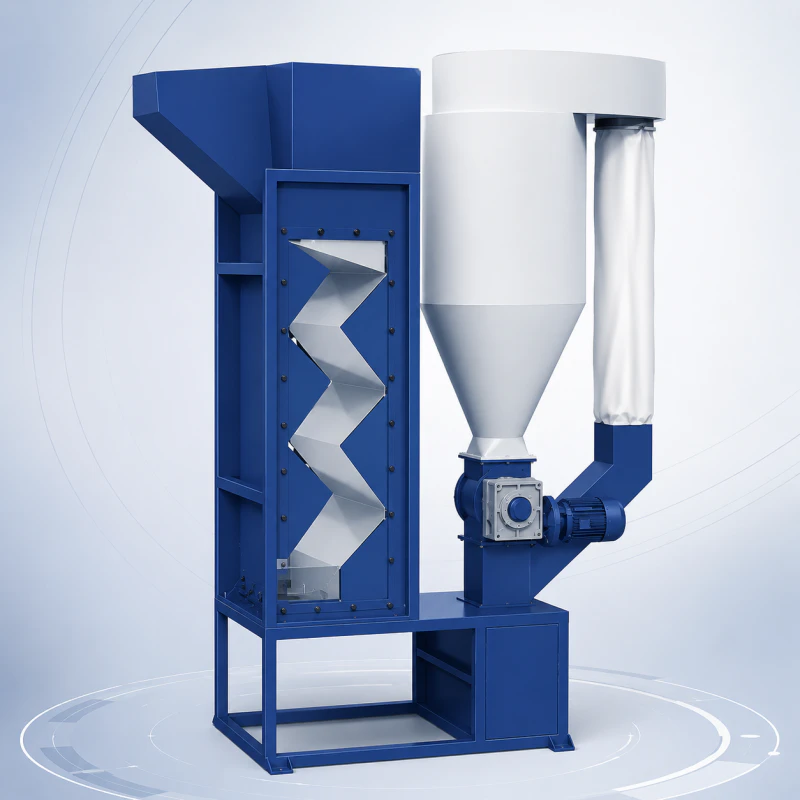
What Is an Air Separation Sorter?
An air separation sorter, commonly referred to as an air jet sorter or pneumatic separator, is a specialized plastic sorting machine that harnesses compressed air to precisely separate materials in a recycling or manufacturing line. At its core, this system integrates high-speed optical sensors—including cameras and near-infrared (NIR) detectors—with a bank of solenoid-controlled nozzles mounted across a conveyor belt or vibrating feeder. As mixed plastics travel past the sensor array, each fragment is analyzed for properties such as color, transparency, or polymer type. The moment a piece matches the user-defined target (e.g., clear PET or green HDPE), the computer triggers a millisecond-long burst of compressed air from a specific nozzle, physically deflecting that item out of the main material stream into a dedicated chute. This contactless ejection method enables extremely high speed and accuracy, as the entire detection-to-ejection cycle repeats hundreds of times per second. The typical physical configuration includes a feed hopper that spreads materials evenly across the belt, a sensor module housed in a protective enclosure, and a row of up to 128 precision nozzles arranged across the full sorting width. Compared to older mechanical sorters that rely on screens or paddles, the air separation sorter offers far greater flexibility—a factory can change sorting parameters via software in seconds rather than swapping out hardware. This characteristic makes it a cornerstone of modern plastic sorting lines, particularly when processing post-consumer bottles, industrial scrap, or mixed polymer streams, where speed and purity are both critical.
How Does an Air Separation Sorter Sort Plastics?
The operational process of an air separation sorter unfolds in three synchronized stages: detection, decision, and ejection. During the detection phase, as mixed plastics travel beneath the sensor array—usually at speeds of 2 to 4 meters per second—cameras capture visible-light images while NIR detectors measure the unique spectral signature of each polymer. For color sorting, cameras analyze every particle in real time, distinguishing between clear, white, blue, green, and other hues with sub-millimeter accuracy. In the decision stage, the central onboard computer cross-references these measurements against pre-loaded sorting criteria—such as "accept only natural PET" or "reject all colored PP"—within microseconds. This logic can be multi-layered; for instance, a machine might first isolate PET, then within that stream separate clear from blue. The final ejection stage executes the physical separation when the computer sends a signal to a high-speed solenoid valve, which opens a specific air nozzle for a controlled duration—typically between 5 and 15 milliseconds. The resulting focused jet of compressed air, at pressures ranging from 4 to 8 bar, delivers enough force to lift even heavy bottle flakes out of the falling curtain of material. After ejection, the deflected pieces land in a clean accept bin while the remaining material continues to a reject container. Because the entire loop occurs on the order of 3 to 5 milliseconds per item, a single sorting head can process tens of thousands of pieces per hour without any mechanical contact, which greatly reduces wear and maintenance demands compared to metal-paddle or drum-based sorters.
What Plastics Can an Air Separation Sorter Detect?
An air separation sorter excels at detecting and separating common packaging and engineering plastics, with specific capabilities determined by the sensor technology installed. For instance, optical sorting systems equipped with visible-light cameras can reliably differentiate between clear and colored versions of PET (polyethylene terephthalate), HDPE (high-density polyethylene), PP (polypropylene), and PS (polystyrene), as well as detect opaque versus transparent parts. When NIR sensors are added, the machine can identify polymer types themselves—for example, telling apart a clear PET bottle from a clear PP cup, even when both appear visually identical. This dual-sensor approach allows sorting streams into streams like "mixed PET and PP," then further separating them into pure fractions. However, there are noteworthy limitations: very dark or black plastics that incorporate carbon black pigment tend to absorb NIR light rather than reflecting it, rendering standard optical sensors partially blind to them. Similarly, fine powders, dusty flakes, or materials with heavy moisture condensation on the surface can scatter light and reduce detection accuracy. Elastomers such as silicone, rubber, or EPDM (ethylene propylene diene monomer) can also be problematic because their spectral signatures may overlap with some polymers or fail to generate a strong enough signal. To overcome these challenges, some advanced sorters integrate mid-infrared (MIR) cameras or hyperspectral imaging that can "see" into different wavelength ranges, enabling identification even of carbon-black plastics. In practice, most recycling facilities address black-plastic limitations by either pre-sorting them manually or by using a combination of air separation sorters for lighter fractions and density-based separation for darker items, ensuring that the entire mixed stream achieves high purity outcomes.
Air Separation Sorter Specifications
When evaluating an air separation sorter for a recycling or manufacturing application, understanding its technical specifications helps match the machine to your throughput and purity targets. Typical industrial units offer a throughput range of 1 to 8 tons per hour, depending on material density (e.g., shredded bottles vs. granules) and sorting width, which commonly varies from 0.5 to 2.0 meters. The number of air channels—each channel corresponds to an individual nozzle—typically falls between 24 and 128, with higher nozzle counts providing finer resolution for sorting small particles. Sorting purity, a key performance metric, is reported at 95% to 99.5% in real-world installations, though reaching the upper end often requires dual-camera setups and multiple sorting passes. Power consumption for the machine itself is modest—5 to 20 kW depending on width and electronics—but the compressed air supply is a separate consideration: and industrial facility may need a dedicated compressor of 5 to 15 kW to support the sorter's peak daily operation. For example, a standard 1.2-meter-wide unit with 64 nozzles can process approximately 3 tons per hour of mixed PET flakes, achieving 98% purity with a single pass, while consuming about 10 kWh of electricity and 30 cubic meters of compressed air per hour. These specifications allow plant managers to size their buffer bins, conveyors, and downstream equipment appropriately, ensuring the sorter integrates seamlessly into an existing material handling system. The high purity figures are especially important for end-market sale of recycled plastics, where buyers often demand 99%+ purity and reject batches containing cross-contamination or colored specs.
Air Separation Sorting vs. Electrostatic Sorting
While both air separation sorters and electrostatic sorters fall under the umbrella of advanced plastic separation technologies, they operate on fundamentally different physical principles, making each better suited for particular applications. An air separation sorter uses mechanical expulsion—a directed air jet to physically displace targeted items based on optical recognition. This method excels at separating lighter materials, such as PET flakes or shredded film, by visible color or polymer type, and can achieve very high throughput with minimal sensitivity to ambient humidity. However, it may struggle with extremely fine particulates below 2 mm, as the weight of such small particles is dominated by adhesion forces like static cling or moisture tension. In contrast, electrostatic sorting relies on differences in triboelectric surface charge: materials receive a charge from a corona or friction field, then are attracted to oppositely charged electrodes. This technique works well for separating mixed polymers that are similar in density but have different charge affinities, such as PVC and PET. Yet electrostatic units require dry, cool operating conditions—ideally with material moisture content below 0.5%—and often need a downstream drying process to prepare feed streams. The choice between the two should be guided by the specific needs of each facility: if your primary requirement is high-speed color sorting of post-consumer container flakes, an air separation sorter offers clear advantages in terms of simplicity, capacity, and lower capital investment. Conversely, if you must separate mixed polymer types that both appear white (e.g., PP and PE in film), electrostatic sorting may be the superior option, despite needing more preprocessing and controlled conditions. Many large-scale facilities now combine both technologies in series, running first an air separation sorter for color sorting, then an electrostatic unit for final polymer-specific separation, maximizing overall purity.
What Industries Use Air Separation Sorters?
The versatility of air separation sorters has led to their adoption across a wide range of industries that process or reclaim plastic materials. The most common application is in plastic recycling plants, where these machines are used to clean PET bottles and HDPE containers by removing colored fragments, metals, and labels. A typical recycling line might process 5 tons per hour of mixed bottles, using an air separation sorter to split the stream into clear, light blue, and green fractions—each sold separately at a premium. Waste-to-energy facilities also rely on air separation sorters to extract high-calorific plastics like PP and PE from municipal waste, diverting them as fuel alternatives while separating inert materials like PVC that can produce harmful emissions. Packaging manufacturers incorporate these sorters into in-house regrind operations: for example, a manufacturer of blow-molded containers may repurpose off-color pellets or start-up scrap by feeding them through an air separation sorter that identifies and rejects non-conforming parts. Electronics waste processors find air separation sorters essential for sorting plastics from shredded printed circuit boards, where the fine metallic content must be removed before plastic can be recycled. Even municipal solid waste (MSW) sorting lines now integrate air separation sorters to extract specific polymer streams for resale, such as mixed polyolefins that can be sold to pelletizers. Each of these industries values the sorter's ability to deliver consistent, programmable separation without the need for manual sorting, reducing labor costs and enabling closed-loop material recovery. As global regulations tighten around plastic waste, operators across these sectors are increasingly turning to air separation sorters as a core piece of equipment for compliance and revenue generation.
How to Choose the Right Air Separation Sorter
Selecting the optimal air separation sorter for your facility requires evaluating several key variables that balance performance, integration, and budget. Begin by analyzing your material type and size: if you process large bottle flakes (10–20 mm), a sorter with a moderate spacing of nozzles (e.g., 32 or 48 channels) will suffice; for fine granules (2–5 mm), higher nozzle density—up to 128 channels—is required to achieve precise targeting without wasting compressed air. Your desired purity level also influences the sensor configuration: if the target is 99.5% purity for premium-grade recycled PET, invest in a dual-camera system (visible plus NIR) with fine nozzle spacing and possibly a second sorting stage. Throughput needs must match the sorting width: a width of 1.2 meters typically handles up to 3 tons/hour for bottle flakes, while a 1.8-meter width can manage 6–8 tons/hour. Ensure the sorter of your choice integrates seamlessly with your existing conveyor speed and air compressor capacity—many units operate at 6–8 bar pressure and require a compressor output of 5–15 kW. Budget negotiations should weigh initial capital expenditure against ongoing operational costs: air separation sorters have a lower upfront cost than electrostatic or density-based separators (typically $50,000 to $200,000 for a mid-range unit), but the cost of compressed air consumption adds roughly $2,000 to $10,000 per year depending on throughput. Finally, consider future scalability: choose a modular system that can accept software upgrades or additional cameras years later, so you can adapt to changing feedstock or market demands without replacing the entire machine. By systematically working through these factors—material size, purity needs, throughput, integration, and cost—you will arrive at a configuration that delivers both immediate sorting performance and long-term return on investment.
FAQ
Can an air separation sorter remove black plastics?
Yes, but with limitations that depend on the sensor technology used. Standard near-infrared (NIR) sensors struggle to detect black plastics because carbon black pigment absorbs most light across the NIR spectrum, producing a weak or indistinguishable signal. However, advanced air separation sorters now incorporate mid-infrared (MIR) cameras or hyperspectral imaging systems that can identify certain black polymers—such as black PP or black ABS—by analyzing their unique reflectance patterns in the non-visible range. In practice, many recycling facilities achieve black plastic removal by running the material through a two-step process: first, a visible-light color sorter removes lighter-colored items; then, the remaining dark fraction passes through a NIR or MIR unit specifically tuned to black waste. For facilities without MIR capability, an alternative approach is to pre-concentrate black plastics using density-based methods (e.g., sink-float tanks) and then feed only the concentrated black stream into the air separation sorter for final cleaning. It is also worth noting that some black plastics contain additives like talc or chalk that show a small spectral fingerprint, enabling detection with very sensitive sensors. In summary, while standard models cannot reliably remove all black plastics, investing in a machine equipped with multi-wavelength imaging or pre-sorting can dramatically improve black plastic capture rates.
What is the typical maintenance schedule for an air separation sorter?
Minimal but regular maintenance is required to keep an air separation sorter operating at peak performance. The air nozzles should be inspected monthly for any blockages caused by dust, metal flakes, or sticky residue from sticky plastics—such as PVC or certain adhesives—as a clogged nozzle will create a sorting void. Optical lenses (camera windows and NIR optics) must be cleaned at least weekly—sometimes daily if the facility processes dusty materials like shredded carpet fines—to maintain detection accuracy. The air compressor filter elements should be replaced every 3 to 6 months, depending on ambient dust levels, to ensure consistent nozzle pressure. Solenoid valves, which trigger each ejection burst, typically last through 5 to 10 million cycles before wear becomes significant; this equates to roughly 1–3 years of continuous operation in a 24/7 plant. Beyond these basic items, it is recommended to perform an annual inspection of the belt drive, bearings, and electrical connections, and to recalibrate the sensor alignment using known reference samples. Following the original equipment manufacturer's list of spare parts, many operators keep a set of at least 3–5 spare solenoid nozzles and a spare lens assembly on hand to minimize downtime during unexpected failures. By adopting this proactive schedule, facilities can sustain sorting efficiency above 98% throughout the year and avoid the costly production interruptions that could otherwise occur from neglected equipment.
How loud is an air separation sorter during operation?
Noise levels from an air separation sorter typically range from 70 to 85 dB(A), measured at a distance of one meter from the machine during full operation. The primary sources of noise include the air compressors (if placed nearby), the rapid opening and closing of solenoid valves, and the pneumatic ejection bursts themselves as compressed air rushes through the nozzles. In open-floor layouts common in recycling facilities, this noise can be noticeable but manageable—many operators use hearing protection within a 10-meter radius as a precaution. For installations concerned with worker comfort or compliance with local noise regulations (often limited to 85 dB over an 8-hour shift), several mitigation strategies are available: enclosing the sorter in an acoustic housing lined with sound-absorbing foam can reduce noise to around 65 dB(A); adding silencers to exhaust ports; and locating the air compressor in a separate room or using a decentralized compressed air network. Some newer models offer "quiet mode" software that slightly extends the valve opening duration to reduce peak noise without significantly affecting sorting speed. In practice, most operators find that the background noise of a conveyor belt, shredder, and other equipment in a recycling plant often exceeds the sorter's output, so the air separation sorter is rarely the primary noise concern in a well-designed facility.