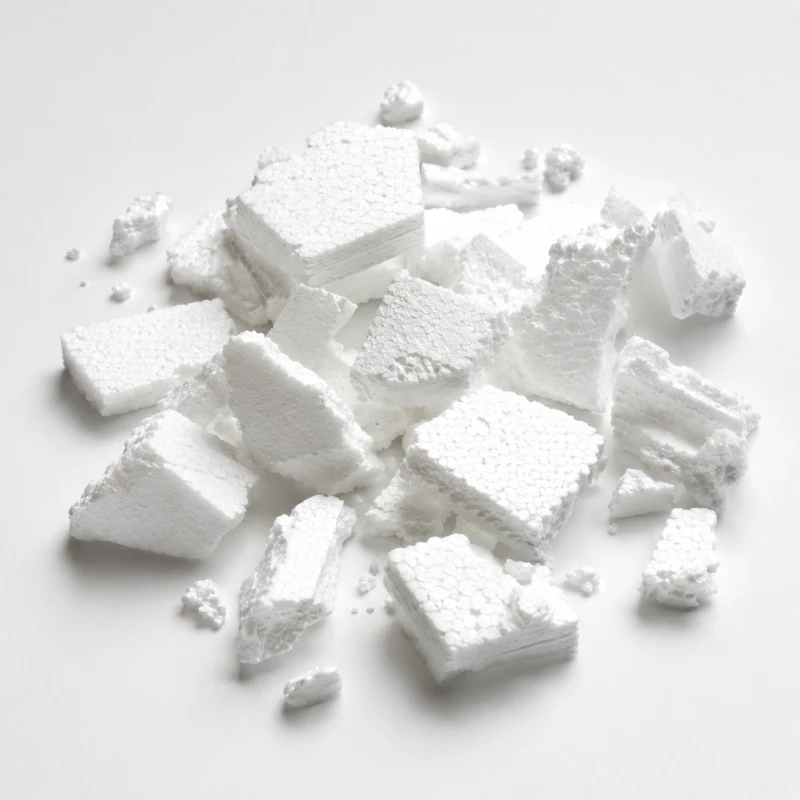
Improve Polystyrene Recovery with Targeted Flake Sorting
Polystyrene (PS) flakes recovered from packaging, household products, electrical equipment, and industrial manufacturing waste can contain mixed colors, unwanted polymers, labels, and other residual contaminants. These materials create different challenges for recyclers seeking consistent feedstock for compounding, extrusion, or other downstream processing applications.
A PS flake sorting solution combines appropriate material preparation with optical detection and targeted separation. Depending on the incoming material, the process can focus on removing unwanted colors, identifying detectable non-PS plastics, or improving the consistency of recovered polystyrene flakes before they enter the next processing stage.
The appropriate configuration depends on the actual feedstock. Clean industrial PS scrap may require a different sorting arrangement from mixed post-consumer plastics or recovered electrical equipment housings. Material composition, flake size, moisture, surface contamination, color distribution, and the intended output specification should all be considered before selecting the sorting technology.
Common Challenges in PS Flake Recycling
PS recycling streams can contain materials that look similar but differ in polymer composition, as well as flakes whose colors vary considerably. A solution designed only for visible color separation may not remove every unwanted polymer, while a polymer-identification system may not address all color-quality requirements. Identifying the main contamination sources helps establish an appropriate sorting strategy.
| Material Challenge | Effect on Recycling | Potential Solution |
|---|---|---|
| Mixed PS colors | Color variation may affect the appearance of recycled products. | Use camera-based color sorting when the target colors can be distinguished visually. |
| ABS, SAN, and other polymer contamination | Unwanted polymers can affect material consistency and downstream processing. | Evaluate NIR-based polymer identification or another suitable separation technology using representative samples. |
| Labels, dirt, and residual materials | Surface contamination can affect product quality and sorting performance. | Consider screening, washing, drying, and sorting according to the contaminant type. |
| Mixed rigid and foam-derived PS | Different flake shapes, sizes, and bulk densities can complicate feeding and handling. | Assess size reduction, screening, material distribution, and suitable sorter design. |
| Black and dark-colored plastics | Some conventional NIR systems may have difficulty identifying carbon-black plastics. | Test the actual material and select a compatible detection or complementary separation method. |
| Wet or overlapping flakes | Poor material presentation can obstruct detection and reduce separation consistency. | Improve drying where necessary and provide a more uniform, well-separated feed stream. |
These challenges do not necessarily require separate machines for every contaminant. The goal is to determine which impurities can be addressed through preparation, which can be detected optically, and which may require an additional separation stage.
Build a Sorting Process Around the Incoming PS Flakes
An effective PS recycling solution starts by understanding the condition of the feedstock. Material preparation, optical inspection, and rejection must work together to achieve the intended separation result. The following stages provide a framework for configuring a line, although not every installation requires every stage.
Prepare and Distribute the Material
Before optical inspection, the feedstock should be checked for excessive dust, moisture, labels, oversized pieces, and other contaminants. Screening, washing, drying, or additional preparation can be included when required by the material condition. Clean, dry flakes with a consistent size range are generally easier to present to an optical sorter than wet or heavily contaminated material.
A feeding system then distributes the flakes into the inspection area. The objective is to reduce overlap and ensure that individual particles can be observed and separated. The choice between a chute-type and a belt-type arrangement depends on flake shape, flow characteristics, size distribution, and the requirements of the application.
Identify Color and Polymer Differences
Camera-based optical sorting evaluates visible characteristics such as color and brightness. It can be suitable for separating light-colored PS from colored fractions or removing visually distinct contaminants when sufficient contrast is available.
When polymer composition is the main concern, near-infrared (NIR) sorting may be considered. NIR sensors analyze material responses that can help distinguish compatible polymer types. The actual ability to separate PS from ABS, SAN, PP, or other plastics depends on the sensor configuration, material condition, and whether the relevant spectral differences can be detected reliably.
Color and polymer identification are different sorting objectives. A dark flake is not necessarily PS, and a light-colored flake is not necessarily free of polymer contamination. Where both appearance and polymer purity matter, the solution should be designed around both requirements.
Separate Accepted Flakes from Target Contaminants
After the detection system classifies the material, the sorting control system coordinates the separation mechanism. In many optical sorting systems, precisely timed compressed-air jets eject selected flakes into a reject outlet, while accepted flakes continue into the product stream.
The sorting recipe should define the target material and the contaminants to be rejected. Depending on the application, the system may remove non-PS plastics, unwanted colors, or selected foreign materials. Output sampling and material testing help determine whether the chosen settings deliver the required balance between product purity and recovery.
Recommended Process Flow for PS Flake Recycling
The appropriate process flow depends on the source of the PS and the condition of the recovered flakes. A packaging recycling line, an electrical equipment recycling line, and a foam recycling line may require different preparation and separation stages.
| Process Stage | Purpose | Application Consideration |
|---|---|---|
| Feedstock inspection | Determine polymer composition, colors, flake dimensions, and contamination types. | Establishes the basis for technology selection. |
| Size reduction and screening | Prepare the material and remove unsuitable particle sizes. | Particularly relevant to bulky packaging, foam, and rigid plastic waste. |
| Washing and drying | Reduce dirt, residues, and moisture when required. | The need depends on the source and cleanliness of the flakes. |
| Color sorting | Separate visually distinguishable colors and selected surface contaminants. | Suitable when color consistency is an important output requirement. |
| Polymer identification and separation | Remove detectable non-PS polymers from the target stream. | Consider when mixed polymer contamination is a primary concern. |
| Output quality inspection | Check purity, residual contamination, and recoverable target material. | Helps establish whether additional sorting or process adjustment is necessary. |
For relatively clean, single-polymer PS flakes, the line may require only limited preparation and targeted optical sorting. For mixed post-consumer or electronic waste, additional separation stages may be needed to manage multiple polymers and contaminants. The process should be selected according to test results rather than assuming every line needs the same equipment sequence.
Choosing Between Optical Sorting and Density Separation
Optical sorting and density-based separation use different physical principles. Optical sorting identifies detectable differences in color or material response, while density separation distinguishes materials according to their density relative to a selected liquid or separation medium. Depending on the feedstock, these methods may be alternatives or complementary stages in a recycling process.
| Comparison Factor | Optical Sorting | Density Separation |
|---|---|---|
| Separation principle | Uses visible characteristics or detectable spectral responses. | Uses differences in material density under controlled separation conditions. |
| Color classification | Can separate distinguishable color fractions when configured for the application. | Does not directly classify materials by visible color. |
| Polymer separation | Can identify compatible polymer types when sensor responses are distinguishable. | Can separate materials when their density behavior differs sufficiently in the selected medium. |
| Process requirements | Requires suitable material presentation, sensor compatibility, and an appropriate rejection system. | Requires liquid or separation-medium handling, material recovery, and associated process management. |
| Best-fit application | Color control and targeted removal of optically identifiable contaminants. | Material mixtures whose density differences support the intended separation. |
Density separation should not be assumed to distinguish every polymer combination. Likewise, optical sorting cannot guarantee the removal of contaminants that the selected sensors cannot detect. A practical evaluation should consider the composition of the feed, the desired separation, water and utility availability, operating complexity, and the quality requirements of the recovered PS.
Applications for PS Flake Sorting Solutions
PS flake sorting supports several recycling scenarios, each with its own material characteristics and output requirements. The most suitable configuration depends on the source of the waste and the contaminants that remain after upstream processing.
| Application | Typical Challenges | Sorting Objective |
|---|---|---|
| Packaging and disposable product recycling | Mixed colors, labels, food residues, and other packaging polymers. | Improve flake cleanliness and color consistency while removing detectable contaminants. |
| Electrical and electronic equipment recycling | Mixed engineering plastics, including PS-based materials and ABS. | Evaluate polymer-identification methods for the specific mixed-plastic stream. |
| Expanded polystyrene recycling | Bulky foam, inconsistent particle sizes, packaging residues, and foreign materials. | Prepare the foam-derived material and remove identifiable contaminants where required. |
| Industrial PS production scrap | Color variations, mixed grades, or contamination introduced during collection and handling. | Recover reusable PS material and control unwanted colors or identifiable foreign polymers. |
| Recycled PS compounding and extrusion | Residual contamination and inconsistent feedstock quality. | Improve incoming flake consistency before downstream processing. |
Optical sorting is one stage in a broader recycling process. It does not replace all washing, melt filtration, or other processing requirements, and the suitability of recovered PS for a particular application must be established against the relevant product specifications.
Configure the Right PS Flake Sorting Solution
A reliable solution should be designed around the material that needs to be recovered, the contaminants that need to be removed, and the quality required at the output. Evaluating these factors before equipment selection helps avoid unnecessary process stages and reduces the risk of choosing a sorter that cannot identify the target materials.
Define the Feedstock Composition
Identify whether the feed consists of packaging waste, foam-derived PS, industrial scrap, electrical equipment plastics, or a mixture of sources. Determine the approximate proportions of PS and other polymers, the range of flake sizes, the color distribution, and the presence of labels, moisture, dust, or dark plastics.
Set the Target Product Requirements
Clarify whether the objective is to produce a more uniform color fraction, remove non-PS polymers, or address several contamination types. The requirements of the downstream customer or processing equipment should guide the selection of sorting criteria and the method used to evaluate the accepted product.
Select the Suitable Sorting Technology
Consider camera-based color sorting for visible color differences and NIR-based sorting for compatible polymer-identification applications. Where the feed contains difficult-to-identify black plastics, rubber, silicone, or other challenging contaminants, determine whether the proposed technology can distinguish these materials before finalizing the design.
Evaluate Throughput, Layout, and Utilities
Sorting capacity should be selected according to the actual feed rate, flake size distribution, contamination level, and required separation quality. The installation review should also cover feeding equipment, compressed-air availability where pneumatic ejection is used, electrical requirements, floor space, reject collection, and integration with existing washing or extrusion equipment.
Validate Performance With Representative Samples
Request testing with representative material before committing to a final configuration. The evaluation should document the accepted-product purity, target-contaminant removal, recovery of usable PS, and operating conditions under which the results were obtained. Testing is particularly important for mixed styrenic plastics, black materials, and feedstocks with highly variable composition.
Frequently Asked Questions About PS Flake Sorting
Can a PS flake sorter separate PS from ABS?
Separation may be possible when the selected sensor system can distinguish the specific PS and ABS materials in the feed. However, performance depends on material formulation, color, surface condition, and sensor capability. Representative sample testing is recommended before choosing a configuration for PS and ABS separation.
Can the same sorting line separate different PS colors?
Camera-based color sorting can separate visually distinguishable PS color fractions when the system is configured for the required task. The achievable result depends on color contrast, flake presentation, surface condition, and the sorting criteria. If polymer identity must also be controlled, color sorting alone may not be sufficient.
Can NIR sorting identify black PS flakes?
Some black plastics, especially those containing carbon-black pigments, absorb near-infrared radiation and can be difficult for conventional NIR systems to identify. Suitability depends on the specific material and detection technology. Testing black PS and any mixed black-plastic fractions is important before selecting the sorting method.
Does a PS flake sorting solution require washing and drying?
Not every feedstock requires the same preparation. Relatively clean industrial scrap may need limited preparation, while post-consumer flakes containing dirt, residues, or moisture may benefit from washing and drying before optical inspection. The preparation stages should be selected according to material condition and the requirements of the complete recycling line.
Can a PS sorter also process other plastic materials?
Some optical sorting platforms can be configured for different compatible materials, but changing the material stream may require different sorting recipes, validation, and cleaning to prevent cross-contamination. The ability to process another polymer should be confirmed with the equipment supplier and tested using the intended feedstock.
How can sorting purity and PS recovery be evaluated?
Purity measures the proportion of the target material in the accepted stream, while recovery measures how much of the available target material is retained. Both should be assessed because aggressive rejection may improve purity while also removing usable PS. Representative material tests can help determine a suitable balance for the intended application.
What information is needed to design a PS flake sorting line?
Useful information includes the source of the flakes, polymer composition, flake size range, color distribution, moisture condition, contamination types, required processing capacity, and target output quality. Sample testing and an assessment of the existing recycling process help establish a suitable sorting configuration.
Develop a PS Flake Sorting Solution for Your Material
PS recycling streams vary widely in composition and contamination. A suitable solution should address the specific challenges of the incoming material, whether the priority is color control, removal of detectable non-PS plastics, or preparation of a more consistent feedstock for downstream processing.
Share your material source, flake characteristics, target contaminants, and required output quality with our team. We can help assess suitable optical sorting options, identify preparation requirements, and develop a process configuration based on your actual recycling conditions.
Contact our team to discuss your PS flake sorting requirements and explore a solution for your recycling line.