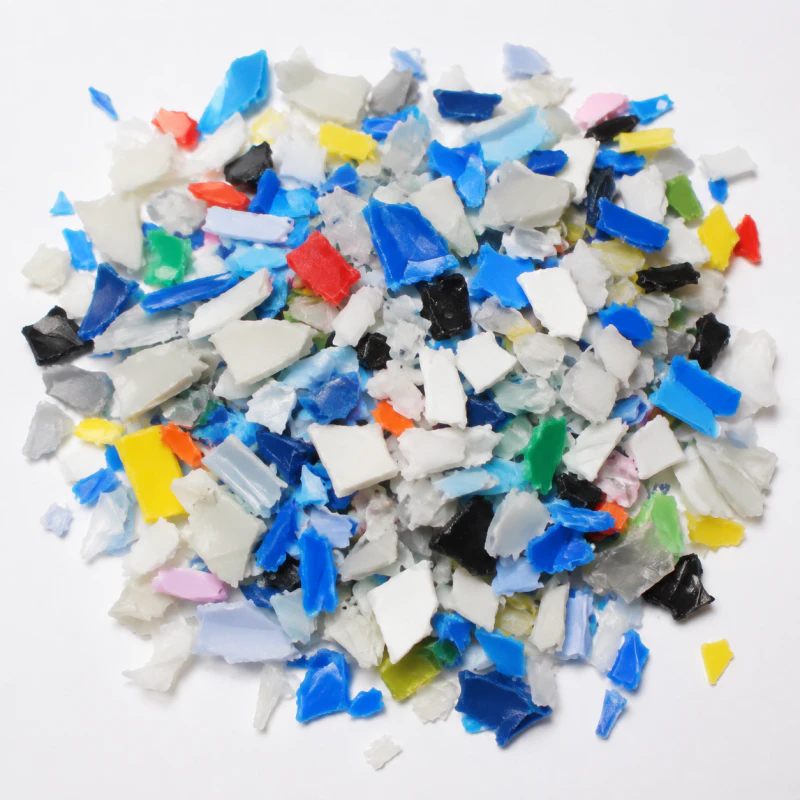
Improve PE and PP Flake Quality with Targeted Sorting
Polyolefin recycling lines often process polyethylene (PE) and polypropylene (PP) flakes recovered from packaging, household products, automotive components, and industrial plastic waste. Although these materials belong to the same broad polymer family, they have different properties and are not interchangeable in every recycling application. Mixed polymers, inconsistent colors, labels, and residual contaminants can therefore affect the quality and market value of recovered flakes.
A polyolefin flake sorting solution combines suitable material preparation with optical identification and targeted separation. Depending on the feedstock, the process may focus on separating PE from PP, removing unwanted colors, or reducing contamination from other detectable plastics. The objective is to produce a more consistent material stream for downstream washing, compounding, extrusion, or pelletizing.
The right configuration depends on the composition and condition of the incoming flakes. A relatively clean PP or HDPE stream may require a different process from mixed post-consumer packaging containing several polymer types. Evaluating the main contaminants, flake size, moisture, surface condition, and target output quality helps determine which technologies are appropriate.
Key Challenges in Polyolefin Flake Recycling
Mixed polyolefin flakes present several separation challenges. Some contaminants have a similar appearance to the target material, while others may be difficult to identify because of their color, surface condition, or physical form. A successful solution should distinguish between problems that can be addressed through material preparation and those that require a dedicated sorting stage.
| Material Challenge | Impact on Recycling | Potential Solution |
|---|---|---|
| Mixed PE and PP flakes | Unwanted polymer content can affect product consistency and downstream processing. | Evaluate NIR-based polymer identification where the target materials can be distinguished reliably. |
| Mixed colors within the same polymer stream | Color variation can limit the use of recycled material in appearance-sensitive products. | Use camera-based color sorting when visible differences are sufficient for classification. |
| PET, PVC, PS, and other polymer contaminants | Foreign polymers can reduce the consistency of the recovered polyolefin fraction. | Select a compatible polymer-identification process and validate its performance on the actual feedstock. |
| Labels, dirt, and residual adhesives | Surface contamination can interfere with detection and affect recycled product quality. | Consider appropriate washing, screening, and drying before optical sorting. |
| Black or dark-colored flakes | Some conventional NIR systems have difficulty identifying carbon-black plastics. | Test the actual material and assess alternative or complementary separation technologies if necessary. |
| Wet, dusty, or overlapping flakes | Poor material presentation can reduce detection consistency and separation efficiency. | Improve feed preparation and distribute flakes more uniformly through the inspection area. |
Not every recycling line requires every sorting function. If the primary problem is mixed color, a color sorter may be sufficient for the required task. If the objective is to separate PE from PP, visible color classification alone cannot reliably establish polymer identity. Defining the main separation objective helps avoid unnecessary equipment and process complexity.
Design a Sorting Process for Mixed Polyolefin Flakes
A practical polyolefin sorting line integrates feed preparation, material identification, and targeted rejection. Each stage should support the next, ensuring that flakes reach the inspection area in a suitable condition and that the selected separation method addresses the contaminants that matter to the final product.
Prepare and Distribute the Flakes
Incoming material should be assessed for particle size, moisture, dust, labels, residual contents, and other contaminants. Screening can remove unsuitable particle sizes, while washing and drying may be necessary for flakes recovered from heavily contaminated post-consumer waste. Preparation requirements vary with the source and condition of the material.
The feeding system should distribute flakes consistently and minimize excessive overlap. Individual flakes need to be presented clearly enough for the selected sensors to inspect them. Flake shape, size distribution, and flow behavior should be considered when choosing between chute-type and belt-type equipment.
Identify Polymer Type and Visible Color
Camera-based optical sorting evaluates visible characteristics such as color, brightness, and surface appearance. It is useful when the target material and contaminants have distinguishable visible features, but similar-looking flakes can belong to different polymer families.
Near-infrared (NIR) sorting can help identify compatible polymers through their spectral responses. In a suitable application, this technology can be used to distinguish PE from PP or identify other detectable polymer contaminants. Performance depends on the sensor configuration, material formulation, surface condition, color, and how clearly the target polymers can be distinguished.
Polymer identification and color classification should be treated as separate functions. If a recycling line requires both PE/PP separation and color control, the solution may need combined sensing capabilities or separate sorting stages. The appropriate arrangement should be determined through feedstock assessment and testing.
Remove Target Materials and Collect Separate Outputs
After classification, the control system coordinates the sorting mechanism to direct selected flakes into the appropriate outlet. In many optical sorting systems, compressed-air jets eject targeted particles into a reject stream while the remaining material continues into the accepted-product outlet.
The system can be configured around the intended output, such as recovering PP from a mixed PE/PP stream or producing a more uniform PE fraction. Depending on the equipment and process design, a second sorting pass may be considered when additional purity or recovery is required. The benefits should be evaluated against the added handling, processing time, and operating costs.
Recommended Process Flow for Polyolefin Recycling
The process sequence should reflect the feedstock source and the condition of the recovered flakes. A post-consumer packaging line may require more intensive cleaning and contaminant removal than a line handling relatively clean production scrap.
| Process Stage | Main Function | When It Is Needed |
|---|---|---|
| Feedstock inspection | Identify polymer composition, colors, flake sizes, and contamination types. | During initial line design or when feedstock conditions change significantly. |
| Size screening and preparation | Remove unsuitable particle sizes and improve material consistency. | When the feed contains excessive fines, oversized pieces, or irregular particles. |
| Washing and drying | Reduce dirt, residues, and moisture that may affect the process. | When required by the condition of the incoming flakes or the target product. |
| Polymer identification | Separate detectable PE, PP, and other compatible polymer categories. | When polymer purity is the main separation objective. |
| Color sorting | Separate visually distinguishable color fractions. | When color consistency is required in the recovered product. |
| Output inspection | Check accepted-product purity, remaining contaminants, and target-material recovery. | When validating performance or determining whether another sorting stage is necessary. |
The sequence is not fixed. Depending on the material and machine configuration, polymer sorting and color sorting may be arranged in different orders or combined in a suitable system. The final layout should also account for the existing washing line, material storage, reject handling, and downstream extrusion or pelletizing equipment.
Optical Sorting Compared with Sink-Float Separation
Optical sorting and sink-float separation are based on different physical principles. Optical sorting evaluates visible or spectral characteristics, while sink-float separation uses differences in material density relative to a selected liquid medium. The most suitable method depends on the polymers involved, the required output, and the operating conditions of the recycling plant.
| Comparison Factor | Optical Sorting | Sink-Float Separation |
|---|---|---|
| Separation principle | Uses visible color or detectable material-specific spectral responses. | Uses differences in density relative to the selected separation medium. |
| PE and PP separation | Can distinguish compatible PE and PP materials when the sensor responses are sufficiently different. | PE and PP can both float in water, so ordinary water-based separation generally cannot reliably distinguish them from each other. |
| Color classification | Can separate detectable color differences when configured for the application. | Does not directly separate flakes according to visible color. |
| Water and drying requirements | Optical inspection is generally a dry sorting stage and requires suitable feed conditions. | Uses a liquid medium and may require subsequent dewatering and drying. |
| Potential role in an integrated line | Final or intermediate sorting of optically identifiable materials. | Pre-concentration or separation of material groups with suitable density differences. |
Sink-float separation can be useful for removing certain heavier contaminants from polyolefin streams, but it should not be assumed to separate PE from PP in an ordinary water bath. Optical sorting may provide an additional separation step when polymer identification or color control is required. In some plants, the two methods can complement each other by addressing different parts of the contamination profile.
Applications for Polyolefin Flake Sorting Solutions
Polyolefin flake sorting can support recycling operations with different material sources and output requirements. The solution should be selected according to the incoming polymer mix and the characteristics expected by downstream users.
| Application | Typical Challenges | Sorting Objective |
|---|---|---|
| Post-consumer packaging recycling | Mixed PE and PP packaging, labels, colored flakes, and other polymer contaminants. | Recover more consistent polymer fractions and control unwanted colors. |
| HDPE bottle and container recycling | PP closures, colored containers, and other mixed packaging materials. | Improve HDPE flake purity and separate detectable contaminants. |
| PP rigid plastic recycling | Mixed colors, PE contamination, and inconsistent feedstock composition. | Recover PP flakes with suitable polymer and color consistency. |
| Industrial production scrap | Mixed production residues, colored materials, or unintended polymer mixing. | Recover reusable material and maintain consistent recycled feedstock. |
| Automotive plastic recycling | Dark plastics, mixed components, and polymer combinations that require careful identification. | Assess suitable identification methods for the actual material stream. |
| Recycled resin and pellet production | Residual cross-contamination and inconsistent flake quality before extrusion. | Improve the consistency of incoming flakes before downstream processing. |
Optical sorting is one component of a complete recycling line. The final properties of recycled resin also depend on washing, melt filtration, extrusion conditions, formulation, and other downstream processes. Sorting requirements should therefore be aligned with the final product specification rather than considered in isolation.
How to Configure the Right Polyolefin Sorting Solution
A suitable configuration begins with a clear definition of the target polymer and the contaminants that need to be removed. This helps determine whether the line needs polymer identification, color classification, additional preparation, or a combination of technologies.
Assess the Feedstock Composition
Identify whether the material comes from post-consumer packaging, rigid containers, automotive components, or industrial production scrap. Determine the approximate proportions of PE, PP, and other polymers, together with the distribution of flake sizes, colors, and surface conditions. Pay particular attention to black plastics and materials that may be difficult for the selected sensors to identify.
Define the Required Output Quality
Establish the target polymer fraction and the acceptable levels of cross-contamination and color variation. The requirements for general recycled compounds may differ from those for appearance-sensitive products. Define both purity and recovery objectives, because a sorting setup that removes more contaminants may also reject a greater amount of usable target material.
Choose Compatible Sorting Technologies
Camera-based color sorting is appropriate when the primary distinction is visible appearance. NIR sorting can be considered when the objective is to identify compatible polymer types. If the feed contains difficult black plastics or contaminants with overlapping sensor responses, evaluate alternative or complementary methods before finalizing the process design.
Match Equipment to Capacity and Plant Layout
The required processing capacity depends on feed rate, flake size distribution, contamination level, and the desired separation quality. Equipment selection should also account for feeding and conveying systems, compressed-air supply where pneumatic ejection is used, electrical requirements, installation space, reject collection, and connections to existing recycling equipment.
Validate Performance Through Material Testing
Representative sample testing is one of the most important steps in selecting a polyolefin flake sorter. Testing should evaluate accepted-product purity, removal of target contaminants, recovery of usable PE or PP, and the operating conditions required to achieve the results. These findings provide a practical basis for choosing the sorting technology and deciding whether a second pass or additional process stage is justified.
Frequently Asked Questions About Polyolefin Flake Sorting
Can a polyolefin flake sorter separate PE from PP?
A compatible NIR sorting system can distinguish PE and PP when their spectral responses can be identified reliably under the actual operating conditions. Performance depends on the specific material, flake condition, color, and sensor configuration. Representative sample testing is recommended before selecting equipment for a dedicated PE/PP separation application.
Can one sorting line handle both polymer and color separation?
It may be possible when the equipment configuration supports both material-identification and color-sorting functions. In other installations, separate sorting stages may be more appropriate. The choice depends on the feedstock, target product, and the performance demonstrated during material testing.
Can ordinary sink-float separation distinguish PE from PP?
Ordinary water-based sink-float separation generally cannot reliably separate PE from PP because both polymers typically have densities below that of water and tend to float. Density separation can still be useful for removing certain heavier contaminants, while a suitable optical or alternative identification method may be required for PE/PP separation.
Can optical sorting handle black polyolefin flakes?
Some black plastics, particularly those containing carbon-black pigments, are difficult for conventional NIR systems to identify. Performance depends on the material and sensor technology. If black PE or PP represents a significant part of the feedstock, it should be included in the sample-testing process.
Does the sorting line require washing and drying?
Preparation requirements depend on the incoming material. Clean industrial flakes may require limited preparation, while post-consumer material containing dirt, labels, or moisture may need washing and drying before optical inspection. Excessive moisture and contamination can interfere with consistent material presentation and detection.
How can output purity be improved without excessive material loss?
Purity and recovery should be evaluated together. More restrictive rejection settings can remove additional contaminants but may also send usable PE or PP into the reject stream. Representative testing, appropriate feeding conditions, and regular output sampling help determine a suitable balance for the target application.
What information is needed to design a polyolefin flake sorting line?
Useful information includes the feedstock source, polymer composition, flake size range, color distribution, moisture condition, black-plastic content, target contaminants, processing capacity, and required output quality. Representative samples and details of the existing recycling process help establish a practical configuration.
Develop a Polyolefin Flake Sorting Solution for Your Recycling Line
Every polyolefin recycling operation has its own combination of feedstock characteristics, contamination challenges, and output requirements. A suitable sorting solution should be designed around the target polymer, the materials that need to be removed, and the quality required by downstream processing.
Share your PE and PP flake samples, material composition, target purity, and processing requirements with our team. We can help evaluate suitable optical sorting technologies, identify preparation requirements, and develop a process configuration tailored to your recycling line.
Contact our team to discuss your polyolefin flake sorting requirements and explore a suitable solution for your application.