What is Sesame Seed Sorting Machine?
A Sesame Seed Sorting Machine is an advanced industrial equipment designed to separate high-quality sesame seeds from defective or contaminated ones based on color differences. It utilizes cutting-edge optical sensing technology to analyze each seed's color profile with precision, ensuring superior sorting accuracy compared to manual methods. This automated system plays a critical role in the food processing industry by enhancing product quality while significantly reducing labor costs.
Modern sesame sorters combine high-resolution CCD cameras with intelligent processing algorithms to detect subtle color variations, mold spots, or foreign materials that might be invisible to human eyes. Unlike traditional winnowing techniques, these machines can process thousands of seeds per second without compromising sensitivity, making them indispensable in large-scale agricultural processing and export-oriented businesses.
How Sesame Seed Sorting Machine Works
The working principle of sesame seed sorter begins with vibration feeders that evenly distribute seeds into a single layer. As the seeds cascade through the detection zone, multiple high-resolution cameras capture detailed images from different angles, analyzing each seed's RGB color components with micron-level precision. The system compares these readings against preset quality parameters stored in its database. When defective seeds are identified, the machine triggers precisely timed air jets that blast them into the reject channel. Advanced models incorporate near-infrared spectroscopy to detect internal quality issues beyond surface color, while adjustable sensitivity settings allow operators to fine-tune sorting strictness according to specific quality standards. The entire process operates in a closed-loop system with self-diagnostic capabilities to maintain consistent performance. | 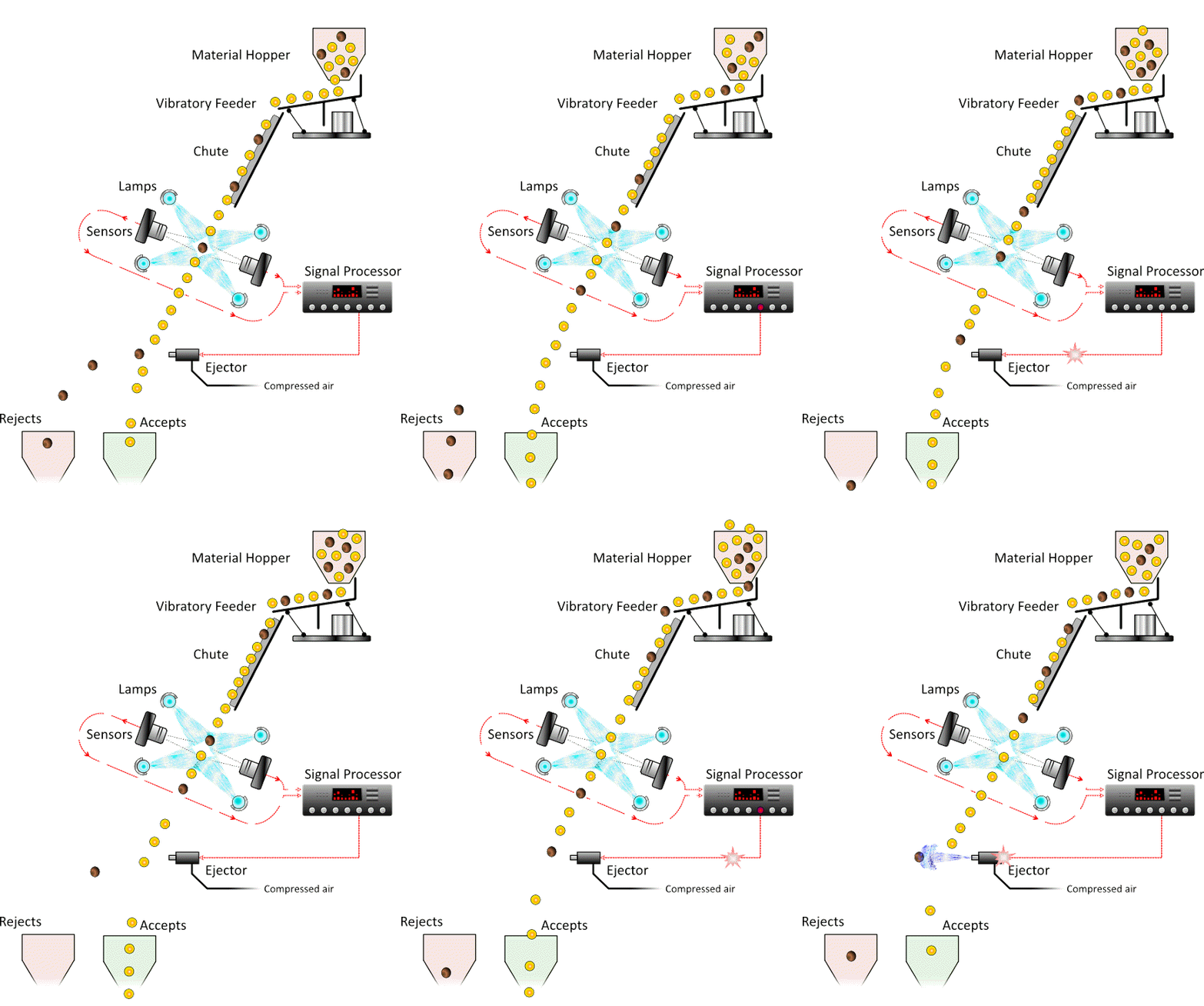 |
Core Features and Advantages
Ultra-High Accuracy
Dual-camera detection systems achieve 99.9% recognition accuracy for superior sorting performance.
Anti-Static Design
Prevents seed adhesion and maintains consistent flow with self-cleaning mechanisms for optical clarity.
Food-Grade Construction
Stainless steel construction ensures food-grade hygiene standards for safe food processing.
24/7 Operation
Continuous operation capability with 30-50% reduction in product loss compared to manual sorting.
Technical Specifications
| Parameter | Specification |
|---|---|
| Processing Capacity | 100 to 400 kg/hour (model dependent) |
| Camera Resolution | 1920x1080 pixels with 0.02mm precision |
| Power Supply | 220V or 380V |
| Compressed Air Requirement | 0.6 - 0.8 MPa |
| Sorting Accuracy | Up to 99.95% |
| Ejection Accuracy | Exceeding 99% |
| Nozzle Configuration | 64 to 256 channels (adjustable) |
| Noise Level | Below 75 dB |
| Floor Space | 1.5 to 2 m² |
| Height | Approximately 1.8 m |
| Connectivity | IoT ready, remote monitoring, predictive maintenance |
| Optional Features | NIR spectroscopy, dual-ejection systems, cloud connectivity |
Advanced models feature NIR spectroscopy for internal quality detection and IoT connectivity for remote monitoring.
Application Scenarios
Seed Processing Plants
Critical role in processing facilities for maintaining high-quality standards in sesame production.
Organic Production
Particularly valuable for organic producers who must maintain standards without chemical treatments.
Export Operations
Essential for export-oriented businesses meeting international food safety regulations and buyer specifications.
Quality Control
Used for secondary quality control after initial cleaning or integrated directly into production lines.
Purchasing Guide
When selecting a sesame sorter, consider throughput requirements matching your production volume. Evaluate camera resolution needs based on defect types in your raw material - smaller defects demand higher resolution. Pay attention to reject mechanisms; dual-ejection systems handle multiple defect types simultaneously. Cloud-enabled models offer better traceability for quality management systems.
Assess after-sales service networks and availability of spare parts. Request material samples for machine testing before purchase. Consider future-proof features like upgradable software and modular designs that allow capacity expansion. Don't overlook energy efficiency ratings and compliance with food safety certifications relevant to your target markets.
Maintenance Guide
Daily maintenance involves cleaning optical lenses and inspecting air nozzles for blockages. Weekly checks should include vibration feeder calibration and belt tension adjustments. Monthly preventive maintenance includes complete air system inspection, checking sensor alignment, and verifying ejection accuracy with test samples.
Always use factory-approved cleaning solutions to avoid damaging sensitive components. Maintain proper environmental conditions - excessive humidity or dust affects performance. Keep detailed maintenance logs to predict component lifecycles. For optimal performance, schedule professional servicing annually to recalibrate optical systems and replace wear parts like filters and gaskets.
Actual Case Comparison
The following table compares two sesame seed processing facilities with similar daily throughput. Facility A uses manual sorting, while Facility B has adopted an advanced AI-driven optical sorter.
| Comparison Metric | Facility A (Manual Sorting) | Facility B (Advanced AI Sorter) |
|---|---|---|
| Sorting Accuracy | Approximately 70-80% (operator dependent) | Over 99% (consistent) |
| Processing Capacity | 20-40 kg/hour | 100-400 kg/hour |
| Good Seed Loss | 10-15% | less than 0.5% |
| Labor Requirement | 10-15 sorters per shift | 1-2 operators per shift |
| Quality Consistency | Highly variable | Uniform across batches |
| Annual ROI | Baseline | 200-300% improvement |
Conclusion
The Sesame Seed Sorting Machine represents a transformative investment for modern seed and food processing operations. By integrating high-resolution optical imaging, AI-powered recognition, and precision pneumatic ejection, it delivers exceptional accuracy, significant labor savings, and consistent product quality. As global food safety standards tighten and consumer expectations rise, advanced sorting technology becomes indispensable for maintaining competitiveness.
From initial cleaning to final grading, the Sesame Seed Sorting Machine ensures excellence at every stage, helping processors maximize yield, minimize waste, and confidently meet market demands. Its adaptability and compatibility with Industry 4.0 systems make it a future-proof solution for businesses of all sizes.