Peanuts are widely used in snack manufacturing, peanut butter production, edible oil processing, confectionery, and ingredient supply. Across these applications, processors must control visible defects and foreign materials while maintaining consistent product quality. Mold-damaged kernels, discoloration, insect damage, broken pieces, shells, stones, and other contaminants can reduce product value, increase manual inspection requirements, and create problems in downstream processing.
A peanut sorting machine helps processors inspect individual kernels and remove selected defects automatically. Instead of relying exclusively on manual inspection, an optical sorting system analyzes the visible characteristics of peanuts moving through the machine and uses a separation mechanism to reject items that match configured defect criteria.
The appropriate sorting solution depends on the raw material, incoming defect profile, required product grade, processing capacity, and acceptable loss of good kernels. A system designed for in-shell peanuts may require a different feeding arrangement and inspection setup from one used for shelled kernels, blanched peanuts, or roasted peanuts.
Which Peanut Defects Can an Optical Sorting Machine Detect?
The defects that can be detected depend on their appearance, the contrast between defective and acceptable kernels, the inspection configuration, and the capabilities of the selected machine. Optical sorting is particularly useful when unwanted materials have distinguishable color, shape, brightness, or surface characteristics.
Mold-Discolored Kernels
Kernels with visible dark patches, unusual surface discoloration, or other appearance changes may be identified when these characteristics differ sufficiently from acceptable product.
Color and Maturity Defects
Abnormally dark, pale, stained, shriveled, or unevenly colored kernels can be separated when the selected detection settings distinguish them from the target grade.
Foreign Materials
Stones, shell fragments, plant debris, and other visible contaminants may be removed when their optical characteristics and size allow reliable identification and separation.
Insect-Damaged Peanuts
Kernels with visible holes, feeding damage, or abnormal surface areas may be recognized if the affected regions are exposed and distinguishable during inspection.
Broken and Deformed Kernels
Shape and size differences can support the removal or grading of broken, undersized, or irregular kernels when these characteristics are included in the sorting criteria.
Shell and Material Variations
For suitable product presentations, the machine can help separate shell pieces and other unwanted materials that differ visibly from the acceptable peanut stream.
How a Peanut Sorting Machine Detects and Removes Defects
An optical peanut sorting system combines controlled material presentation, optical inspection, image processing, and a physical separation mechanism. Each stage contributes to the final sorting result. Stable feeding helps expose kernels to the inspection area, consistent lighting improves image quality, and properly configured rejection timing helps remove targeted defects without unnecessarily discarding acceptable product.
Optical Inspection and Targeted Ejection
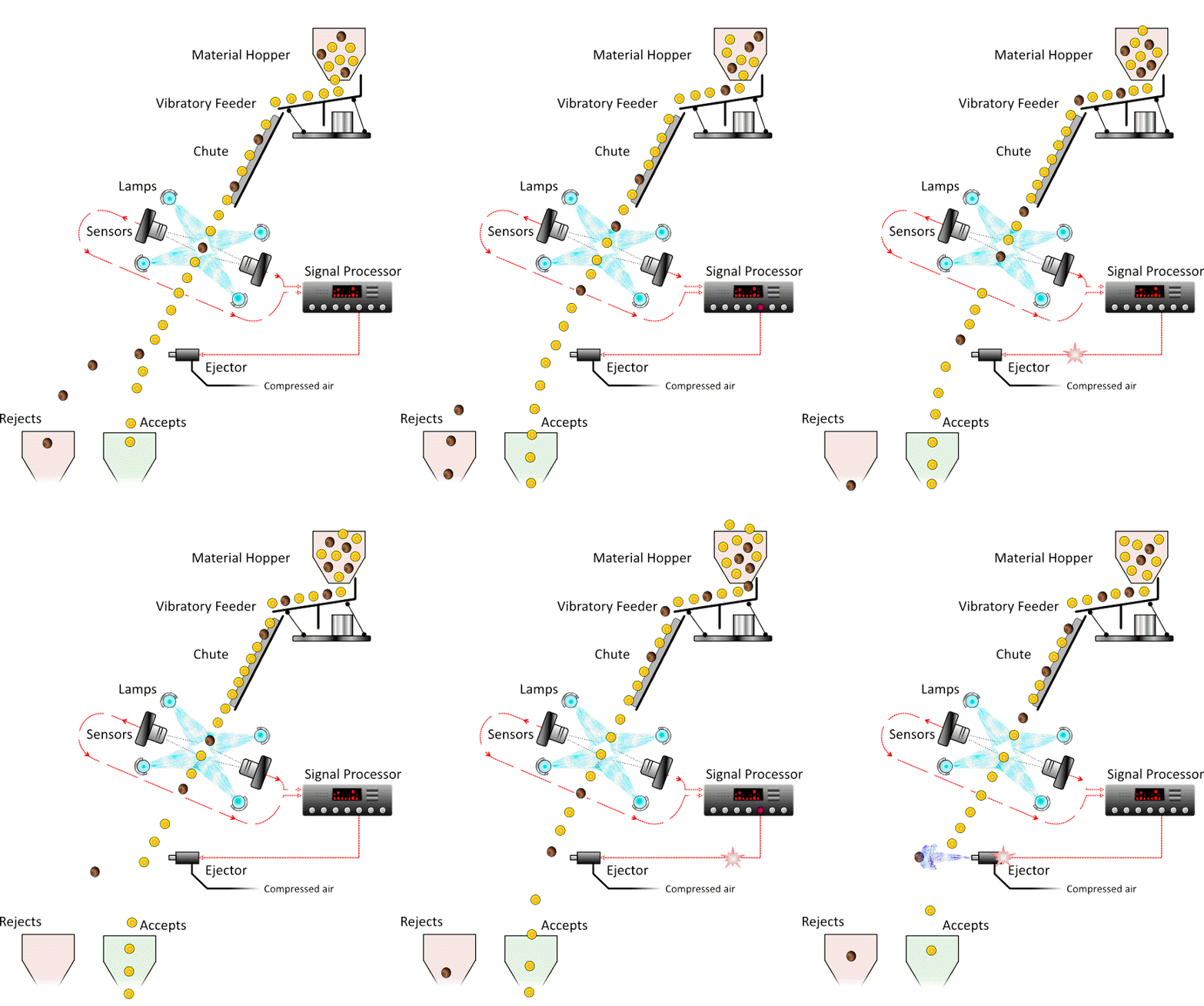
Peanuts are distributed through the feeding system and move past an inspection area. Cameras capture images of the material, and the processing system evaluates relevant characteristics against the configured sorting criteria.
When a kernel or foreign particle is classified for rejection, the control system coordinates the separation mechanism with the material's position. In an air-ejection design, a precisely timed air pulse diverts the selected item into the reject channel, while acceptable material continues toward the product outlet.
The accuracy of this process depends on stable feeding, clear optical contrast, correct system setup, suitable ejection timing, and the physical behavior of the material. Actual results should be verified using representative peanuts from the intended production line.
Material Feeding and Presentation
Before inspection, the raw peanuts should be distributed as evenly as practical. Excessive overlap can hide defective surfaces or make individual kernels difficult to distinguish. An uneven feed can also change the material flow and reduce the consistency of the inspection process.
Feed conditions should be matched to the product form. Shelled kernels, in-shell peanuts, blanched peanuts, and roasted peanuts can differ in size, shape, surface texture, and flow behavior. The feeding system and operating settings should therefore be tested with the actual material rather than selected solely from nominal capacity figures.
Image Capture and Defect Classification
Cameras capture the appearance of peanuts as they pass through the inspection zone. Depending on the equipment configuration, the system may evaluate color, brightness, shape, size, and visible surface patterns. Image-processing software then compares observed characteristics with configured acceptance and rejection criteria.
A defect is easier to identify when its appearance contrasts clearly with acceptable kernels. A dark spot on a light kernel, for example, may be easier to distinguish than a subtle surface change on a similarly colored kernel. Defects hidden beneath other kernels or located on an unexposed surface may be more difficult to detect.
Rejection and Product Collection
Once a target defect has been identified, the machine determines when to activate the relevant separation point. In pneumatic systems, an air jet diverts the selected material from the main product stream. The rejected fraction is collected separately for inspection, reprocessing where appropriate, or disposal according to the processor's quality procedures.
Correctly timed ejection is important because the machine must remove the targeted item without disturbing too much adjacent material. If the reject stream contains excessive acceptable peanuts, operators may need to review the sorting threshold, material presentation, feed rate, or air-ejection settings.
How Different Detection Criteria Support Peanut Defect Removal
No single visual characteristic can identify every peanut defect. A practical sorting setup uses the characteristics that are most relevant to the incoming material and the desired finished grade. The table below summarizes common inspection criteria and their typical applications.
| Detection Criterion | Potential Application | Key Consideration |
|---|---|---|
| Color and brightness | Darkened, stained, pale, or unevenly colored kernels | Performance depends on contrast, lighting, and the natural color variation of the product. |
| Surface appearance | Visible mold-like patches, insect damage, and surface blemishes | The affected region must be visible and sufficiently different from acceptable material. |
| Shape and size | Broken, undersized, oversized, or irregular kernels | Natural variation in peanut varieties may overlap with the dimensions of defective kernels. |
| Foreign-particle appearance | Visible stones, shell pieces, plant debris, and other contrasting contaminants | Detection depends on particle size, exposure, and the contrast with the peanut stream. |
| Additional sensor channels, where equipped | Selected materials with differences that may not be obvious in ordinary color images | Capabilities depend on the actual sensor configuration and must be confirmed through material trials. |
For most applications, the goal is not simply to maximize the number of rejected items. A useful sorting program must balance defect removal with the recovery of acceptable peanuts. Overly aggressive settings may remove more defective kernels but can also increase good-product loss. Less aggressive settings may preserve more product while allowing some defects to remain.
Choosing a Peanut Sorting Machine for Different Processing Stages
The best sorting arrangement depends on where the machine is installed and what the processor needs to achieve. Incoming raw peanuts may contain a different defect mix from peanuts that have already been cleaned, shelled, blanched, roasted, or prepared for packaging.
| Processing Stage | Typical Sorting Objective | Points to Evaluate |
|---|---|---|
| Raw peanut cleaning | Remove visible foreign materials and selected defective kernels before further processing. | Incoming contamination, feed consistency, particle size, and acceptable material loss. |
| Shelled peanut processing | Improve kernel appearance by removing selected discolored, broken, or damaged kernels. | Kernel size variation, exposed surface area, and color differences between grades. |
| Blanched peanut processing | Identify selected appearance defects on kernels after skin removal. | Surface contrast, kernel handling, and the required appearance specification. |
| Roasted peanut processing | Separate visibly over-roasted, burnt, or unevenly colored kernels where optical contrast allows. | Normal roast-color variation, product temperature, surface oil, and handling conditions. |
| Final ingredient or snack preparation | Perform a final optical inspection before subsequent manufacturing or packing. | Required final grade, line capacity, hygiene procedures, and integration with existing equipment. |
Raw Peanut Sorting
Raw peanuts can contain soil-related debris, shell fragments, immature kernels, insect-damaged peanuts, and kernels with visible discoloration. Sorting at an early stage can reduce the amount of defective material entering downstream equipment. However, optical sorting should be considered alongside appropriate mechanical cleaning and other processing steps, since different contaminants require different removal methods.
Blanched and Shelled Peanut Sorting
Shelled and blanched kernels expose more of the kernel surface for inspection than intact in-shell peanuts. This can make some color and surface defects easier to evaluate. At the same time, kernel overlap, broken pieces, and natural differences in size may complicate classification. A machine trial should establish whether the selected settings meet the target grade without excessive loss of acceptable kernels.
Roasted Peanut Sorting
Roasting introduces additional color variation. Kernels may range from lightly roasted to darker brown, and the acceptable range depends on the product specification. A peanut sorting machine can be configured to identify selected abnormal colors, including visibly burnt kernels, when these differ sufficiently from the desired roast profile. Sorting thresholds should be established using representative production samples to avoid rejecting acceptable variation.
Key Factors That Influence Peanut Sorting Accuracy
Sorting performance is influenced by the complete operating setup, not only by the camera or image-processing software. The following factors should be reviewed during equipment selection, installation, and production optimization.
Balancing Defect Removal and Good-Kernel Recovery
Processors should evaluate both the quality of the accepted product and the composition of the rejected fraction. A machine that removes many defects but also discards a large quantity of good kernels may create unnecessary product loss. Conversely, a low reject rate does not automatically indicate good performance if defective kernels remain in the accepted stream.
A representative trial should use a known incoming sample, record the amount of material processed, inspect the accepted and rejected fractions, and compare the results against the customer's quality requirements. Tests should be repeated when incoming material changes significantly.
How to Evaluate Peanut Sorting Performance
Performance should be verified using measured results from the intended product and operating conditions. Instead of relying on generic accuracy claims, processors can use the following indicators to compare machine settings and trial results.
| Performance Indicator | What It Measures | How to Evaluate It |
|---|---|---|
| Defect removal rate | The proportion of targeted defects removed from the incoming material. | Compare the quantity of target defects removed with the total quantity of those defects in the incoming sample. |
| Accepted-product purity | The proportion of acceptable material in the product stream after sorting. | Inspect a representative accepted-product sample and measure the remaining defects or contaminants. |
| Good-product loss | The quantity of acceptable peanuts incorrectly directed to the reject stream. | Manually inspect the reject fraction and measure the amount of acceptable product it contains. |
| Throughput | The quantity of material processed over a defined period. | Record actual production rate under the required sorting settings rather than relying only on nominal capacity. |
| Operating stability | The consistency of results over time and across production batches. | Repeat sampling under comparable conditions and record changes in purity, losses, and throughput. |
Practical Trial Procedure
Begin by collecting a representative sample of the incoming peanuts. Record the initial material quantity and, where feasible, classify the main defect types. Run the sample through the machine using an agreed initial setup, then collect both accepted and rejected fractions separately.
Inspect each fraction to determine which defects were removed, which remained in the accepted stream, and how much acceptable material entered the reject stream. Adjust the settings and repeat the test if necessary. The final operating configuration should reflect the balance between product purity, good-kernel recovery, and the required processing rate.
Integrating a Peanut Sorting Machine into a Production Line
A peanut sorting machine should be selected as part of the complete processing line. Upstream cleaning, conveying, grading, shelling, blanching, roasting, and downstream packing operations can all influence how the sorter performs. An otherwise suitable machine may deliver inconsistent results if the incoming material is poorly distributed or if the production line regularly exceeds the machine's practical operating capacity.
Upstream Preparation
Remove contaminants that are more effectively handled by conventional cleaning equipment before optical sorting where appropriate. Stable material flow helps reduce sudden surges and uneven loading. For products containing a wide range of kernel sizes, the processor should determine whether pre-grading or a different feeding arrangement would improve inspection consistency.
Reject Collection and Handling
Rejected material should be collected in a way that allows operators to inspect it and assess the sorting result. Keeping the reject stream separate supports quality checks and helps identify whether settings are too aggressive. Any reprocessing of rejected peanuts should follow the facility's food-safety procedures and product specifications.
Cleaning, Inspection, and Routine Maintenance
Dust, residue, and surface deposits can affect optical inspection if they accumulate on relevant machine components. Follow the manufacturer's cleaning and maintenance instructions, including the recommended procedures for optical windows, feeding surfaces, and separation components. Maintenance should be performed safely and at intervals appropriate to the operating environment and product conditions.
Food Safety Considerations When Sorting Mold-Damaged Peanuts
Peanut quality management requires more than visual inspection. Mold growth and mycotoxin contamination are related concerns, but they are not interchangeable measurements. Some visibly damaged kernels may be removed through optical sorting, while some contaminated kernels may not display obvious external symptoms. The effectiveness of visual sorting also varies with the defect type, the condition of the kernel, and the machine configuration.
Processors should combine sorting with supplier qualification, appropriate drying and storage practices, prevention of moisture accumulation, hygienic handling, representative sampling, and laboratory testing where required. Sorting performance should be validated against the applicable food-safety plan and destination-market requirements.
How to Select the Right Peanut Sorting Machine
Before purchasing equipment, define the material form, target defects, required finished-product grade, expected throughput, and acceptable good-product loss. These details help determine whether a standard color-based inspection system is suitable or whether the application requires a more specialized configuration.
| Selection Question | Why It Matters | Information to Prepare |
|---|---|---|
| What type of peanut will be processed? | Different product forms have different feeding, handling, and inspection requirements. | Raw, shelled, blanched, roasted, whole, or broken kernels. |
| Which defects must be removed? | Detection depends on the visual or sensor characteristics of each target defect. | Representative samples of acceptable peanuts and each major defect type. |
| What purity level is required? | Sorting thresholds must reflect the customer's quality specification. | Product-grade criteria, defect tolerances, and inspection procedures. |
| What throughput is required? | Capacity needs to be evaluated together with inspection quality and recovery. | Normal and peak feed rates, operating hours, and production-line constraints. |
| How will results be verified? | Measured trials help confirm that the proposed configuration suits the actual material. | Test samples, acceptance criteria, sampling method, and evaluation records. |
A supplier evaluation should include a material test whenever possible. Ask for clear documentation of the test conditions, including the sample type, incoming defect profile, throughput, accepted-product quality, reject composition, and good-product loss. Results from a different peanut variety or processing stage may not accurately predict performance on the intended production line.
Conclusion: Improve Peanut Quality with Targeted Optical Sorting
A peanut sorting machine can help processors improve product consistency by identifying and removing selected visibly defective kernels and foreign materials. By combining stable feeding, optical inspection, image-based classification, and correctly timed separation, the system can reduce dependence on manual inspection and support more consistent quality control.
The most suitable solution depends on the peanut product form, defect characteristics, required purity, throughput, and acceptable product loss. A representative material trial is the practical way to determine whether the machine can meet these requirements under real operating conditions.
For applications involving suspected mold damage or food-safety risks, optical sorting should be integrated with appropriate testing, storage controls, and documented quality procedures. This approach helps processors evaluate equipment on measurable sorting performance while maintaining a broader focus on product quality and safety.